
DRIVING HISTORY, ONE MILE AT A TIME

The Cadillac Self Starter
De man die de wereld vergiftigde: Thomas Midgley Jr., 'Ethyl' en de marketing van het gevaar
Je kunt ervoor kiezen om wel of niet te roken, maar je kunt de lucht die je inademt niet kiezen. En decennialang bevatte die lucht een onzichtbaar, maar verwoestend gif: lood. Het verhaal over hoe lood in onze brandstof terechtkwam leest als een meeslepende thriller, waarin briljante techniek, ongekende hebzucht en doortrapte marketing samenkomen.
Het probleem van de elektrische startmotor
Het verhaal begint in de vroege jaren van de auto-industrie. In 1912 rustte General Motors de Cadillac uit met een revolutie: de elektrische startmotor, uitgevonden door Charles "Boss" Kettering en zijn bedrijf DELCO. Deze uitvinding maakte de gevaarlijke handzwengel overbodig, maakte autorijden toegankelijk voor het grote publiek (in het bijzonder voor vrouwen) en veegde stoom- en elektrische auto's definitief van de kaart.
Maar er was een probleem. De luxe Cadillacs vertoonden een alarmerende neiging om te kloppen of te pingelen: een scherp, metaalachtig geluid dat ontstond door een te vroege ontbranding in de cilinders, wat de motoren vernielde. Critici gaven Kettering de schuld.
Kettering zette zijn assistent, een jonge ingenieur genaamd Thomas Midgley Jr., op het probleem.
Van gesmolten boter tot het perfecte gif
Tastend in het duister had Midgley al snel geluk toen hij jodium aan de brandstof toevoegde. Dit stopte het kloppen in een testmotor en bewees voor eens en voor altijd dat het probleem te maken had met de explosieve eigenschappen van de brandstof (wat later het octaangetal werd genoemd). Jodium verhoogde het octaangetal en verhielp het kloppen; het was echter corrosief en onbetaalbaar duur.
Geïnspireerd door deze fundamentele doorbraak zette Midgley zijn brandstofonderzoek voort. Hij testte elke stof die hij kon vinden op antiklopeigenschappen: van kamfer, ethylacetaat en aluminiumchloride tot letterlijk gesmolten boter. Helaas hadden de meeste stoffen "net zoveel effect als spugen in de Grote Meren".
Na duizenden stoffen te hebben getest, stuitte hij op 9 december 1921 in het laboratorium van General Motors in Dayton, Ohio, op de perfecte remedie: tetraethyllood (ook wel TEL genoemd). Een klein drupje van dit mengsel in de benzinetank liet de motor als een zonnetje lopen en verhoogde het vermogen.
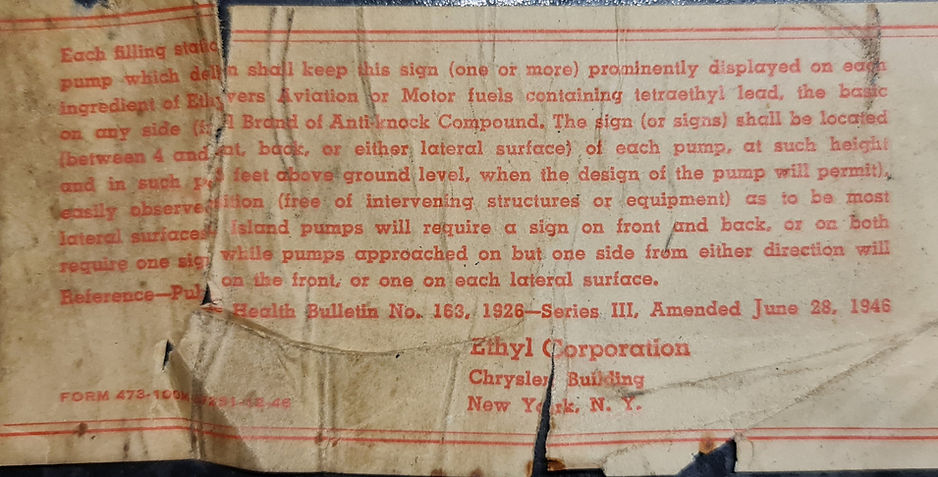
Er was alleen één gigantisch obstakel. Tetraethyllood was al in 1854 ontdekt door een Duitse chemicus, maar werd nooit commercieel gebruikt vanwege de "bekende dodelijkheid ervan". Contact met de stof veroorzaakte hallucinaties, ernstige ademhalingsproblemen, verlamming, waanzin en de dood.


This deceptively simple device made it possible for everyone, regardless of their
strength, to a multi-cylinder combustion engine to start without being afraid of
injury from the hand crank itself or when the engine had a backfire.
Indeed you could die while starting your car until Charles Kettering de
electric starter invented. In early 1908, a woman's Cadillac struck in Detroit, Michigan
off. She didn't have enough power to crank the engine again to see him again
start. A passing motorist offered to help. His name was Byron Carter
and he happened to be a friend of Cadillac founder Henry Leland. Carter was the founder
from CarterCar, a company that GM had acquired in 1909 for its knowledge of friction
transmissions.
Carter tried to crank the car. This went wrong. the hand crank hit him in the
face and broke his jaw. Carter was hospitalized but due to infection and
gangrene from the wound he died from his injuries. Antibiotics did not exist then.
Carter's death led Leland to promise that Cadillac would buy its cars from the
hand crank would redeem. He enlisted the help of Charles Kettering, the co-founder
of Dayton Engineering Laboratories Company. Better known by its abbreviation: DELCO.
Kettering was an inventor/businessman, along the lines of by Thomas Edison. He was born on a farm and had a range of different simple jobs until he started working at the National Cash Register Company (NCR), where he invented the electric motor for cash registers. Then he set up DELCO together with his partner Edward Deeds in 1909. The company built the electric starter for Cadillac at short notice. Just as the cash drawer opened with the push of a button, an engine could be started. Finally a key was used to start. The system was tested in 1911 and introduced in Cadillac's 1912 models.
Charles F. Kettering got on August 17, 1915 the US patent no. 1,150,523 for its "engine-starting device", the first electric ignition for cars.
The invention had direct impact on the automotive industry. Within five years, self-starters would be standard on almost every new car. By making cars easier and safer to operate, especially for women, the self-starting car a huge jump in sales. The American auto industry never looked back....
DELCO was bought by General Motors (GM) in 1919 and Kettering became GM's chief technology officer. During his time at GM, he oversaw the development of leaded gasoline, Duco's quick-drying paint, lightweight diesel engines for trains and trucks, and GM's first OHV V8; the Oldsmobile Rocket 88.
When he died in 1958, he held 140 patents in his own name. That's why he's often quoted as, "If you want to kill an idea in the world, get a committee to work on it."
The beautiful website theoldmotor.com contains some noteworthy reactions to this video. I have placed these below and have chosen not to translate them.
DAVID GREENLEES January 18, 2014 at 8:22 am
It is a very complex system as were most early starting systems. Basically it involved the use of four six-volt batteries and a rotary switch that combined the voltage, resulting in twenty-four volts going to the starter. After starting the system reverted back to six-volts and the six-volt generator charged the batteries which provided current for the lights and other electrical features.
The “view port” you mention was referred to as a sight-glass back in the period and it was used to view the output of the oil-feed plunger pump that helped lube the engine.
TOM GUNTHER January 18, 2014 at 11:01 am
As the owner of a 1912 Cadillac, I should note that the system is problematic at best, and was ditched after 1912 for an “improved” system on later cars. The rotary switch is subjected to hot switching large currents and the contacts suffer from arcing and ultimately open. A great innovation, but like most first tries it had significant flaws.
ROSS BARTON January 19, 2014 at 7:09 pm
I recently just rewired a 1913 model 30. Although very improved over the 12, it was still a very complicated system which still utilized the magnetic coil to engage the starter. The later cars also used a complex rotary switch which changes the grounds between not only the starter and generator circuits but also between the starting and running distributors! Fascinating when it all works. Thanks so much for sharing, great stuff!
TONY COSTA January 20, 2014 at 4:43 pm
A 1912 Cadillac was a mid-mid price car, as the market went. at $1,800, it was 3 times the amount my Grandfather made working
12 hour days, 6 days a week, in a year(I have his 1911 pay envelope with a $2.50 gold piece in it). Luxury cars started at about 2 times
the cost of a Cadillac (though some very fine cars could be purchased in the high $2,000's to $3,500's). An open Chadwick costs 3 times what a Cadillac did and it wouldn't be the most expensive open luxury car available.
JOE TOTTON January 20, 2014 at 7:45 pm
This sort of switch is referred to as a series/parallel switch. The modern ones are usually magnetic coil operated. I have seen this kind of system on diesel truck engines. Also Cummins used a compression release (a starting aid) on the 855cid engines until 1977. By pulling a lever on the front of the engine it opened the exhaust valves slightly. It worked pretty good in cold weather.

To demonstrate the reliability of its new self-starter, Cadillac trusted pure on the electric motor to drive this four-cylinder Cadillac chassis (loaded with a dozen passengers) around a room in 1912. Who these 12 gentlemen are is unknown.




_edited.jpg)
.webp)
.webp)
.webp)