DRIVING HISTORY, ONE MILE AT A TIME

Life is one Cadillac after another
The early 1950s were a time of great prosperity
Waar Harley Earl Cadillac in de jaren vijftig jaarlijks verraste met spectaculaire Dream Cars, sloeg Bill Mitchell een andere weg in. Conceptauto's moesten volgens hem niet langer fantasieën voor een verre toekomst zijn, maar realistische voorstudies voor toekomstige productiemodellen. Daardoor verschenen in de jaren zestig nog slechts enkele Cadillac-concepts, zoals de Pininfarina Jacqueline, de LaSalle XP-715 en de XP-840 Eldorado Fastback. Hun invloed was echter groot: zij vormden de opmaat naar Mitchells strakke, tijdloze Cadillac-design van de tweede helft van de jaren zestig.
Cadillac Jacqueline (1961)
Toen Bill Mitchell eind 1958 Harley Earl opvolgde als vicepresident van General Motors Styling, veranderde ook de visie op conceptauto's. De extravagante Dream Cars van de Motorama maakten geleidelijk plaats voor elegantere ontwerpen die dichter bij de werkelijkheid stonden. Een van de eerste auto's die deze nieuwe filosofie belichaamde was de Cadillac Jacqueline.
In tegenstelling tot vrijwel alle eerdere Cadillac-concepts werd de Jacqueline niet in Detroit ontworpen. Bill Mitchell wilde onderzoeken hoe een Europese interpretatie van een Cadillac eruit zou zien en gaf daarom opdracht aan het Italiaanse carrosseriehuis Pininfarina om een exclusieve luxe coupé te ontwikkelen. Er is echter ook nog een ander verhaal.
Pinin Farina bouwde de 1959-1960 Eldorado Brougham in Turijn, maar had géén invloed op het ontwerp daarvan. Nadat Cadillac het verliesgevende Brougham-programma beëindigde, probeerde Pininfarina Cadillac te overtuigen met een serie eigen ontwerpen. Dat verklaart waarom de Jacqueline überhaupt ontstond. Volgens Cadillac-historicus Yann Saunders hoopte Pinin Farina met de Jacqueline Cadillac te overtuigen om vanaf 1962 een nieuwe generatie coachbuilt Eldorado Broughams te bouwen.
Het resultaat werd in 1961 gepresenteerd. De "Jacqueline" maakte deel uit van een kleine reeks ontwerpstudies op Cadillac-basis die Pininfarina tussen 1958 en 1961 ontwikkelde. Deze serie bestond uit slechts vier modellen: de Skylight coupé en cabriolet (1958), de Starlight coupé (1959) en de Jacqueline. Van deze vier zijn voor zover bekend alleen de Skylight Coupé en de Jacqueline Coupé bewaard gebleven. De auto was vernoemd naar Jacqueline Kennedy, die na de inauguratie van John F. Kennedy in januari van dat jaar wereldwijd uitgroeide tot een stijlicoon. Hoewel Cadillac of Pininfarina dit nooit officieel bevestigden, wordt algemeen aangenomen dat de naam een eerbetoon aan de nieuwe First Lady was. Haar elegante en moderne uitstraling sloot perfect aan bij het karakter van de auto. Bij de eerste show werd de auto nog voorgesteld zonder emblemen met de modelnaam.
De Jacqueline week op vrijwel ieder punt af van de Amerikaanse designtraditie. Waar Cadillacs uit de jaren vijftig bekendstonden om enorme vinnen, overvloedig chroom en flamboyante details, koos Pininfarina voor een bijna architectonische eenvoud. De carrosserie was lang, laag en strak. De vinnen waren teruggebracht tot subtiele lijnen en het chroom was tot een minimum beperkt. Net als bij de Eldorado Brougham was het dak van gepolijst RVS. De nadruk lag op perfecte verhoudingen en een rustige, bijna tijdloze vormgeving.
Opvallend was de grote glaspartij met uiterst slanke dakstijlen, waardoor het interieur uitzonderlijk licht oogde. De grille bleef onmiskenbaar Cadillac, maar was veel verfijnder geïntegreerd dan gebruikelijk. De lange motorkap, de vloeiende daklijn en de ingetogen achterzijde gaven de auto een Europese elegantie die destijds ongekend was voor een Amerikaans luxemerk.
Hoewel de Jacqueline nooit voor productie was bedoeld, liet hij zien dat Cadillac ook zonder overdreven decoratie indrukwekkend kon zijn. Veel ontwerpers beschouwen hem als een van de zuiverste Cadillac-ontwerpen ooit gebouwd. Leuk detail is dat de grille overgenomen lijkt op de latere Peugeot 204. Kon Pinin Farina toch nog iets gebruiken van de Jacqueline.
De invloed op de latere productie bleef beperkt. Amerikaanse kopers verwachtten begin jaren zestig nog steeds grote, imposante Cadillacs met veel chroom. Toch vormde de Jacqueline een belangrijk signaal dat de ontwerpwereld veranderde. De nadruk verschoof van ornament naar vorm, van versiering naar proportie. Die ontwikkeling zou in de jaren zestig steeds duidelijker zichtbaar worden, zowel bij Cadillac als bij andere luxemerken.
Vandaag de dag is de Cadillac Jacqueline een gewaardeerde conceptauto uit het Mitchell-tijdperk. Niet vanwege futuristische techniek of spectaculaire experimenten, maar juist vanwege zijn ingetogen elegantie. De auto bewees dat een Cadillac ook indruk kon maken door eenvoud en perfecte proporties.
De auto die op de autosalon in het Grand Palais werd tentoongesteld was verre van compleet. Hij beschikte niet over een motor, transmissie, stuurinrichting of wielophanging. In plaats daarvan rustte de carrosserie op een buizenframe dat was gemonteerd op trailerassen. Ondanks deze beperkingen was de Jacqueline een van de grote blikvangers van de tentoonstelling en wist hij iedereen die hem zag te imponeren.
Na zijn rondgang langs diverse autosalons werd de Jacqueline opgenomen in het museum van Pininfarina, waar hij meer dan dertig jaar verbleef. Gedurende die periode verscheen de auto slechts zelden in het openbaar.
Halverwege de jaren negentig werd de conceptcar verkocht aan Alain Dominique Perrin, destijds president van Cartier. Daarmee kreeg de Jacqueline haar eerste en enige geregistreerde eigenaar. Perrin, een gepassioneerd verzamelaar van zeldzame en bijzondere auto's, besloot de auto om te bouwen tot een volledig rijklaar voertuig.
De lijst met eigenaren is bekend en luidt:
-
Pininfarina Museum
-
Philippe Lancksweert
-
Michel Kruch / Hervé Irving Willems
-
Alain-Dominique Perrin
-
Harbor Auto Restorations
-
uiteindelijk weer Hervé Irving Willems
Voor de restauratie werd de carrosserie geplaatst op het chassis van een 1960 Cadillac Eldorado Biarritz. Daarnaast werd een 390 cubic inch (6,4 liter) V8 uit 1959 gemonteerd, goed voor 325 pk. De auto kreeg tevens een viertraps Hydra-Matic automatische transmissie, een onafhankelijke voorwielophanging met schroefveren, een starre achteras met bladveren en hydraulisch bekrachtigde trommelremmen rondom.
Sinds deze restauratie is de Jacqueline volledig rijklaar. Er is echter nauwelijks mee gereden; de kilometerstand beperkt zich vrijwel uitsluitend tot de kilometers die na de restauratie zijn afgelegd. Het grootste deel van het interieur, waaronder de karakteristieke uit één stuk gevormde kuipstoelen, is trouw gebleven aan het oorspronkelijke ontwerp van Pininfarina, al zijn veel onderdelen aangepast zodat ze volledig functioneel zijn.
De Jacqueline vormt daarmee een tastbaar bewijs van Pininfarina's vooruitstrevende ontwerpfilosofie en van de ambitie om Italiaanse elegantie te combineren met de techniek en luxe van Cadillac. De ontwikkeling van een niet-rijdende showauto tot een volledig functionerende automobiel onderstreept zowel de blijvende aantrekkingskracht als de historische betekenis van deze uitzonderlijke conceptcar.
Wil je meer weten? The New Cadillac Database

The new OHV V8 from 1949


Starlight


Skylight Convertible


Starlight Coupe


De andere concepts van de sixties
De LaSalle XP-715 is al beschreven bij het stuk over LaSalle na 1940. Het werd de basis voor de 1963 Buick Riviera. De XP-840 Eldorado Fastback was geen concept die op shows kwam te staan maar meer een stylingexercise.
Cadillac XP-840 Eldorado Fastback (1965): Het V16-Luxe-Experiment
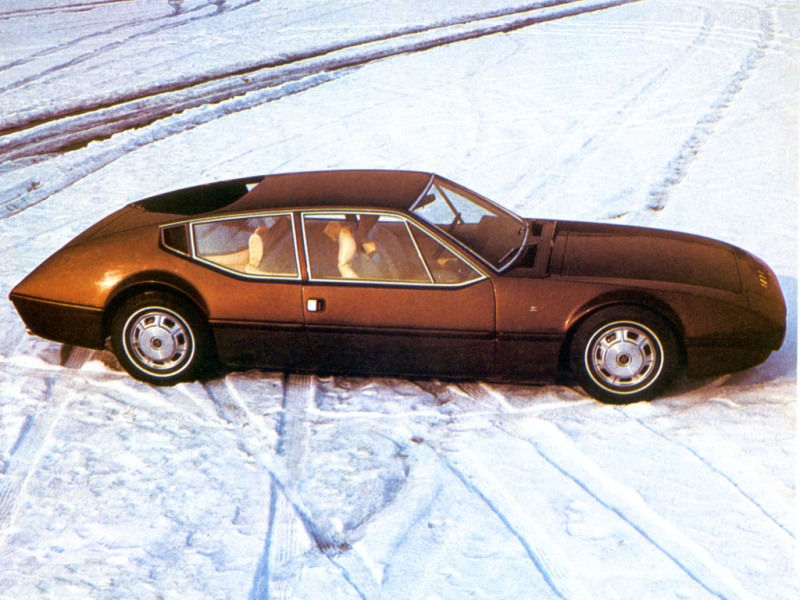
In 1965 tekenden de ontwerpers van Cadillac de XP-840 Eldorado Fastback, een van de meest gewaagde concepten uit de geschiedenis van het merk. Wat begon als een reeks "cartoonachtige" schaalmodellen om het imago van Cadillac op te frissen, kreeg in december 1965 de officiële status van een Xperimental Project (XP-840).
Het resultaat was een full-scale kleimodel (mockup) van een extreem lage, tweepersoons coupe met een extreem lange motorkap en een dramatisch aflopende fastback-daklijn—een favoriet stijlelement van GM’s designbaas William L. Mitchell. Het project was puur bedoeld als een interne stijlstudie onder leiding van hoofd design Chuck Jordan.
Unieke Ontwerpelementen
De XP-840 introduceerde een reeks visuele noviteiten die destijds revolutionair waren voor General Motors:
-
Geen achterruit, maar een TV-camera: De auto had helemaal geen traditionele achterruit of binnenspiegel. In plaats daarvan was er een smalle sleuf in het dak gefreesd die diende als kijkgaatje voor een achteruitrijcamera.
-
Geen zichtbare A-stijlen: Een diep getekende neus, een V-vormige motorkap en een gigantische panoramische voorruit die naadloos overging in de cockpit, zonder zichtbare A-stijlen.
-
Klassieke knipogen: Aan de zijkant van de motorkap zaten geribbelde uitstroomopeningen (cuffs) die subtiel verwezen naar de externe uitlaatpijpen uit het klassieke tijdperk van de jaren dertig.
-
Zwevende achterpanelen: Een diep verzonken achterpaneel tussen opvallende, uitstekende achterspatborden (outriggers).
Hoewel de typeplaatjes op de auto de naam "Eldorado" droegen, was dit voornamelijk uit gemak gekozen en niet bedoeld als direct productiemodel.
Een Hypothetische V16
Hoewel het voertuig nooit verder kwam dan een niet-rijdend kleimodel, was de extreem lange motorkap van de XP-840 in theorie ontworpen rond een monstrueuze V16-motor. Dit blok zou worden opgebouwd uit twee aan elkaar gekoppelde Cadillac V8-motoren. In de praktijk had Cadillac in de jaren zestig echter geen enkele commerciële behoefte aan een V12 of V16, waardoor het motorproject nooit werd gerealiseerd.
De Erfenis van de XP-840
Hoewel de auto nooit het productiestadium haalde, was het project niet voor niets. Verschillende designelementen van de XP-840 – zoals de dubbele taillelijn en de verhoudingen van de achterpanelen – sijpelden later door in productiemodellen van Cadillac.
Voormalig GM Design Director Chuck Jordan vatte het project later zo samen:
"We hebben het project uiteindelijk laten varen nadat het schaalmodel op volle grootte klaar was. We hadden te veel andere dingen te doen, en we waren hier bezig met een full-size kleimodel dat we nooit aan het publiek wilden tonen. Het was puur een stijloefening."


1952. This was Cadillac's 50th anniversary year. There are only minor changes in styling and trim but some are specifically designed to celebrate the occasion. For example, the V decals on the hood and boot lid were done in gold. The 62 Sedan got a higher tailgate, creating extra luggage space. Reversing lights were now standard and incorporated into the taillights. At the rear, all models now feature a new Cadillac trademark, a dual exhaust system incorporated into the bumper. The decals on the trunk lid varied by series. Standards now included self-winding clocks, dual drive Hydra-Matic, improved turn signals, anti-dazzle mirror and much more. Hydra Matic for the 75 was $186, windshield washer $11, oil filter $11, power steering $198, high beam sensor $52 and power windows $139. Cadillac had the most powerful car in the US auto industry this year and sales were booming. The 1,300,000th Cadillac of all time was built.
A military order was won for T41El Walker Bulldog tanks and T41 twin 40mm gun motor vehicles for the Korean War.
Styling and horsepower sold cars in the 1950s, and no one knew that better than Cadillac. Although the styling changed from year to year, Cadillac made sure to maintain the continuity of the design, even though the car always looked "new", there could never be a mistake of being anything other than "The Standard". of the World". Cadillac also enhanced its image with some of the most stylish advertisements of the time. In the early 1950s, she produced a series of advertisements showing the car above a necklace of diamonds, emeralds or rubies, with simple, direct mini-stories below. For example, one of them told of the paperboy who had admired Cadillacs for 31 years and was now an industrialist about to buy his first: "No compromise this time!" cried the ad.
Three GM divisions celebrated their 50th anniversary in 1952 and that was celebrated with expensive limited editions, all large convertibles. Buick offered the Skylark for $5,000, which was $1,500 more expensive than a Roadmaster Convertible and Oldsmobile's 98 Fiesta, which costs $5,715. For the price difference with the Super 88 Convertible you could buy a base 88 2 on. Cadillac's anniversary model appeared in the Series 62 as the Eldorado. Only 533 were built that year, largely due to a skyrocketing price of $7,750. The 3 specials were taken off the line and partly built by hand. Even with the high selling prices, no profit was made on these models. The attractions: custom interior, special "Panoramic" windshield, sporty beltline and a metal lid instead of a canvas hood to cover the folded hood. Incidentally, 28,000 '53 Cadillacs were equipped with a Buick Dynaflow automatic after a fire at the Hydra-Matic factory in Livonia.
Eldorado, in proper Spanish, El Dorado, means "The Gilded One (the Gilded One)". Legend has it that it was a legendary golden kingdom, a place of fantastic riches that was believed to be located in the snow-capped mountains of what is now Colombia. Over the years, "Eldorado" has come to represent the best of everything: opulence, wealth, the good life. So it was a completely logical choice to use this name for a stunning new Cadillac convertible. The name was sought through an internal competition to find a name for the car marking the company's anniversary. A secretary from the merchandising department, Mary-Ann Marini, won that competition. Her winning name was adopted for the new Cadillac.
The original Eldorado can be viewed in the same light as the V16 from 23 years before. Although the Eldorado was different. Instead of staid, classical dignity, he had flair and zest and was flamboyant. But like the Sixteen, it cost the world $7,750, 87 percent more than the standard Series 62 convertible. For that kind of money, the buyer could have actually bought three cars: a Cadillac 62 convertible, a Pontiac sedan, and a Chevrolet business coupe. Also, like his ancestor of the 1930s, he was scarce. Only 532 were built in the first model year.
Many saw the Eldorado for the first time on television. The date was January 20, 1953 and Dwight D. Eisenhower, World War II's most popular hero, was wheeled down Pennsylvania Avenue to his first inauguration as President of the United States. We saw the popular new leader of the Free World riding - from above - in the back seat of this sporty, yet elegant car. By the way, think about that for a moment. 1953 is not that long ago. Yet here the President of the United States was driving in an open car. No armor plate. Not bulletproof glass. No protection and none of us thought anything of it. America had not yet lost its innocence. However, we couldn't take our eyes off that beautiful Eldorado, the most glamorous machine we'd ever seen come out of post-war Detroit.
Modeled after a 1952 'concept car', the '53 'Eldorado' was the first of GM's Harley Earl 'dream machines' to enter production, albeit on a limited scale and along with the Chevrolet Corvette from 1953. Characteristic were the new "panoramic" windshield that foreshadowed things to come. It was three inches lower than the Series 62 and had a longer, slimmer appearance, although the overall length was the same. The interior was upholstered in the finest leather and the chrome wire wheels gave an extra touch of elegance. Standard equipment included a radio, heater, tires with white sidewalls, power steering and a Hydra-Matic. Aircondition could be ordered for $620. If there was any doubt that Cadillac was supreme in the prestige class, the Eldorado took that doubt away. The futuristic Le Mans show car of 1953 had a major influence on the design of the Eldorado of 1954.
Coupes with jambs didn't make a comeback in '54, but the Eldorado did. Just a year later, Cadillac thought they had made a point with the Eldorado, but they also knew that 532 cars couldn't make money. It was time for a new kind of Eldorado, one that could be sold in large numbers and thus yield a significant profit. So the 1954 model was of a different breed and thus sold for a different price: $5,738, more than $2,000 less. Although the '54 Eldorado was easily recognizable with ribbed bare metal on the lower rear fenders and gold Cadillac logos, it was much less distinctive than the original. Still, the price was right, even though it was "only" $1,300 more expensive than the 62's. Despite a somewhat short model year, the Eldorado found 2,150 buyers. This rose to 3,950 units in '55 and twice as many for '56, when the Eldorado series was expanded with a hardtop coupe, the Seville. It was priced the same at $6,556 as the now renamed Biarritz convertible.
The 1954 Cadillac received many exterior changes. This included a lower, slimmer body and, for the first time, an integrated bumper/grill that incorporated two huge chrome bullets that soon became known as "Dagmars", in honor of well-endowed NBC TV star of the time Virginia Ruth. egnor. Round dual exhausts were incorporated into the vertical bumper ends and the rear bumper was completely redesigned. A panoramic windscreen was standard on all models. Sedans had a separate molding above the windshield, creating a built-in sunvisor effect. Coupes had a curved rear window that became known as a "Florentine" style window. A wide air intake under the windshield was now featured on all models.
The Series 62 chassis had a brand new longer wheelbase that also put them about 140 pounds heavier. A feature of this model was the lack of louvres on the rear wing. The hood and tailgate featured V decals and logos and there were full-length scuff plates in shiny metal. The Coupe DeVille's had scripts on the rear pillars of the hardtop. The Eldorado (which is still considered a Series 62) had gold decals and had ribbed panels behind the rear wheels to emphasize this part. Made of extruded aluminum, these panels also sat on a unique Eldorado coupe built for the president of Reynolds Aluminum Co. Also included with the production convertible were the wire wheels and custom interior trims and the Cadillac logo embossed on the seat backs. Automatic windshield washers, power steering, 12-volt electrical system and aluminum pistons made it to the long list of standard equipment for the first time this year. The Series 62 four-door sedan was now seven inches shorter than the other models. Another one-off creation was an exclusive Sedan DeVille. Power brakes are $48, radio $120, air conditioning $620, chrome wire wheels $325. Assembly of the 1954 models began on January 4, 1954 after a 25-day shutdown for the transition to the new production line. Fiberglass-built Cadillac show cars such as the Park Avenue four-door sedan, El Camino coupe and La Espada convertible appeared at the GM Motorama show.
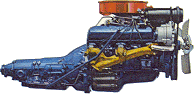
Power continued to be provided by the division's landmark 331 CUI overhead valve V8 which first appeared in 1949. Although power increased from 210 to 230, there were no further changes. In fact, the numbers for '53 were intentionally understated to facilitate this business acumen. The Eldorado still had the stock Cadillac engine and impressive list of standard features of its predecessor, but it now used the exact same bodywork as the Series 62 Cabrio, with no bodywork changes as on the '53.
The 1955 Eldorado was more striking than the '54. Rocketship tail fins above the round taillights adorn the rear fender, making the Eldorado instantly recognizable. Fender skirts were eliminated and the wheel recesses were enlarged, the better to show off the flashy new "Sabre-spoke" wheels. They were intended to be introduced in the 1958 model year, but these exclusive wheels had become available exclusively for the Eldorado. An addition to the dashboard of each of these fine cars was a small brass plaque engraved with the owner's name. It was felt that Cadillac had taken it too easy in '54. The Eldorado could too easily be seen as a luxury 62 convertible. That wouldn't happen now! The other models kept the small fin taillight design that had become a Cadillac signature. The division's basic '54 look was maintained for 1955 and '56 through effective evolutionary facelifts. In 1956 Cadillac introduced the first four-door hardtop Sedan de Ville, which immediately scored almost as many sales as the Coupe de Ville and standard 62 combined.
While there have been no major changes to the appearance of Cadillacs this year, a number of refinements were apparent.
The grill was redesigned with wider spaces between the strips and the parking lights were placed directly below the headlights.
On the sides of the body, the bumpers formed a right angle with the vertical edge of the rear doors or fenders of the series 62 and 60S models. This accentuated the line of the sheet metal. The Florentine curved rear window was now also used for the sedans. Three chrome moldings bordered either side of the rear number plate. The Coupe DeVille had a gold nameplate on the C-pillar. Tubeless tires were available for the first time. The power of the Cadillac engine seemed to increase with sales. For 1955, the power reached 250 hp thanks to a higher compression (9.0: 1) and an improved manifold. The use of dual four-speed carburetors gave the Eldorado an extra dose of vitamin, bringing its advertised horsepower to 270, a number matched only by the 275-hp Packard Caribbean. According to Motor Life Magazine, this gave the Eldorado a theoretical top speed of 117 miles per hour. Remarkably, Cadillac kept the price of this beautiful car low. At $5,814, it was only $76 more expensive than the much less distinctive (and less powerful) 1954 version. Of course production went ahead again, to 3,950 units this time. That figure would be the highest ever for the open Eldorado. Motor Trend magazine reported fuel economy figures of 12.9 miles per gallon (stop-and-go) for a Series 62 sedan with the standard 250 horsepower V-8.
Total 1955 output for all models reached 140,777 units, a new record for Cadillac.
The 1955 Eldorado is a certified Milestone Car.
The Park Avenue sedan, a futuristic show car that became the predecessor to the Eldorado Brougham, appeared at the New York Motorama on January 19, 1955.
It was built in less than 74 days! Another show car seen this year was the Celebrity hardtop coupe.
William 'Bill' Mitchell


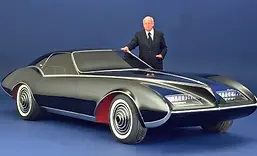
De laatste auto die Bill ontwierp voordat hij met pensioen ging. Een auto waarvan hij heeft gezegd 'die wil ik zelf wel rijden'. De 1977 Pontiac Phantom
.jpg)















1952. This was Cadillac's 50th anniversary year. There are only minor changes in styling and trim but some are specifically designed to celebrate the occasion. For example, the V decals on the hood and boot lid were done in gold. The 62 Sedan got a higher tailgate, creating extra luggage space. Reversing lights were now standard and incorporated into the taillights. At the rear, all models now feature a new Cadillac trademark, a dual exhaust system incorporated into the bumper. The decals on the trunk lid varied by series. Standards now included self-winding clocks, dual drive Hydra-Matic, improved turn signals, anti-dazzle mirror and much more. Hydra Matic for the 75 was $186, windshield washer $11, oil filter $11, power steering $198, high beam sensor $52 and power windows $139. Cadillac had the most powerful car in the US auto industry this year and sales were booming. The 1,300,000th Cadillac of all time was built.
A military order was won for T41El Walker Bulldog tanks and T41 twin 40mm gun motor vehicles for the Korean War.
Styling and horsepower sold cars in the 1950s, and no one knew that better than Cadillac. Although the styling changed from year to year, Cadillac made sure to maintain the continuity of the design, even though the car always looked "new", there could never be a mistake of being anything other than "The Standard". of the World". Cadillac also enhanced its image with some of the most stylish advertisements of the time. In the early 1950s, she produced a series of advertisements showing the car above a necklace of diamonds, emeralds or rubies, with simple, direct mini-stories below. For example, one of them told of the paperboy who had admired Cadillacs for 31 years and was now an industrialist about to buy his first: "No compromise this time!" cried the ad.
Three GM divisions celebrated their 50th anniversary in 1952 and that was celebrated with expensive limited editions, all large convertibles. Buick offered the Skylark for $5,000, which was $1,500 more expensive than a Roadmaster Convertible and Oldsmobile's 98 Fiesta, which costs $5,715. For the price difference with the Super 88 Convertible you could buy a base 88 2 on. Cadillac's anniversary model appeared in the Series 62 as the Eldorado. Only 533 were built that year, largely due to a skyrocketing price of $7,750. The 3 specials were taken off the line and partly built by hand. Even with the high selling prices, no profit was made on these models. The attractions: custom interior, special "Panoramic" windshield, sporty beltline and a metal lid instead of a canvas hood to cover the folded hood. Incidentally, 28,000 '53 Cadillacs were equipped with a Buick Dynaflow automatic after a fire at the Hydra-Matic factory in Livonia.
Eldorado, in proper Spanish, El Dorado, means "The Gilded One (the Gilded One)". Legend has it that it was a legendary golden kingdom, a place of fantastic riches that was believed to be located in the snow-capped mountains of what is now Colombia. Over the years, "Eldorado" has come to represent the best of everything: opulence, wealth, the good life. So it was a completely logical choice to use this name for a stunning new Cadillac convertible. The name was sought through an internal competition to find a name for the car marking the company's anniversary. A secretary from the merchandising department, Mary-Ann Marini, won that competition. Her winning name was adopted for the new Cadillac.
The original Eldorado can be viewed in the same light as the V16 from 23 years before. Although the Eldorado was different. Instead of staid, classical dignity, he had flair and zest and was flamboyant. But like the Sixteen, it cost the world $7,750, 87 percent more than the standard Series 62 convertible. For that kind of money, the buyer could have actually bought three cars: a Cadillac 62 convertible, a Pontiac sedan, and a Chevrolet business coupe. Also, like his ancestor of the 1930s, he was scarce. Only 532 were built in the first model year.
Many saw the Eldorado for the first time on television. The date was January 20, 1953 and Dwight D. Eisenhower, World War II's most popular hero, was wheeled down Pennsylvania Avenue to his first inauguration as President of the United States. We saw the popular new leader of the Free World riding - from above - in the back seat of this sporty, yet elegant car. By the way, think about that for a moment. 1953 is not that long ago. Yet here the President of the United States was driving in an open car. No armor plate. Not bulletproof glass. No protection and none of us thought anything of it. America had not yet lost its innocence. However, we couldn't take our eyes off that beautiful Eldorado, the most glamorous machine we'd ever seen come out of post-war Detroit.
Modeled after a 1952 'concept car', the '53 'Eldorado' was the first of GM's Harley Earl 'dream machines' to enter production, albeit on a limited scale and along with the Chevrolet Corvette from 1953. Characteristic were the new "panoramic" windshield that foreshadowed things to come. It was three inches lower than the Series 62 and had a longer, slimmer appearance, although the overall length was the same. The interior was upholstered in the finest leather and the chrome wire wheels gave an extra touch of elegance. Standard equipment included a radio, heater, tires with white sidewalls, power steering and a Hydra-Matic. Aircondition could be ordered for $620. If there was any doubt that Cadillac was supreme in the prestige class, the Eldorado took that doubt away. The futuristic Le Mans show car of 1953 had a major influence on the design of the Eldorado of 1954.
Coupes with jambs didn't make a comeback in '54, but the Eldorado did. Just a year later, Cadillac thought they had made a point with the Eldorado, but they also knew that 532 cars couldn't make money. It was time for a new kind of Eldorado, one that could be sold in large numbers and thus yield a significant profit. So the 1954 model was of a different breed and thus sold for a different price: $5,738, more than $2,000 less. Although the '54 Eldorado was easily recognizable with ribbed bare metal on the lower rear fenders and gold Cadillac logos, it was much less distinctive than the original. Still, the price was right, even though it was "only" $1,300 more expensive than the 62's. Despite a somewhat short model year, the Eldorado found 2,150 buyers. This rose to 3,950 units in '55 and twice as many for '56, when the Eldorado series was expanded with a hardtop coupe, the Seville. It was priced the same at $6,556 as the now renamed Biarritz convertible.
The 1954 Cadillac received many exterior changes. This included a lower, slimmer body and, for the first time, an integrated bumper/grill that incorporated two huge chrome bullets that soon became known as "Dagmars", in honor of well-endowed NBC TV star of the time Virginia Ruth. egnor. Round dual exhausts were incorporated into the vertical bumper ends and the rear bumper was completely redesigned. A panoramic windscreen was standard on all models. Sedans had a separate molding above the windshield, creating a built-in sunvisor effect. Coupes had a curved rear window that became known as a "Florentine" style window. A wide air intake under the windshield was now featured on all models.
The Series 62 chassis had a brand new longer wheelbase that also put them about 140 pounds heavier. A feature of this model was the lack of louvres on the rear wing. The hood and tailgate featured V decals and logos and there were full-length scuff plates in shiny metal. The Coupe DeVille's had scripts on the rear pillars of the hardtop. The Eldorado (which is still considered a Series 62) had gold decals and had ribbed panels behind the rear wheels to emphasize this part. Made of extruded aluminum, these panels also sat on a unique Eldorado coupe built for the president of Reynolds Aluminum Co. Also included with the production convertible were the wire wheels and custom interior trims and the Cadillac logo embossed on the seat backs. Automatic windshield washers, power steering, 12-volt electrical system and aluminum pistons made it to the long list of standard equipment for the first time this year. The Series 62 four-door sedan was now seven inches shorter than the other models. Another one-off creation was an exclusive Sedan DeVille. Power brakes are $48, radio $120, air conditioning $620, chrome wire wheels $325. Assembly of the 1954 models began on January 4, 1954 after a 25-day shutdown for the transition to the new production line. Fiberglass-built Cadillac show cars such as the Park Avenue four-door sedan, El Camino coupe and La Espada convertible appeared at the GM Motorama show.
Power continued to be provided by the division's landmark 331 CUI overhead valve V8 which first appeared in 1949. Although power increased from 210 to 230, there were no further changes. In fact, the numbers for '53 were intentionally understated to facilitate this business acumen. The Eldorado still had the stock Cadillac engine and impressive list of standard features of its predecessor, but it now used the exact same bodywork as the Series 62 Cabrio, with no bodywork changes as on the '53.
The 1955 Eldorado was more striking than the '54. Rocketship tail fins above the round taillights adorn the rear fender, making the Eldorado instantly recognizable. Fender skirts were eliminated and the wheel recesses were enlarged, the better to show off the flashy new "Sabre-spoke" wheels. They were intended to be introduced in the 1958 model year, but these exclusive wheels had become available exclusively for the Eldorado. An addition to the dashboard of each of these fine cars was a small brass plaque engraved with the owner's name. It was felt that Cadillac had taken it too easy in '54. The Eldorado could too easily be seen as a luxury 62 convertible. That wouldn't happen now! The other models kept the small fin taillight design that had become a Cadillac signature. The division's basic '54 look was maintained for 1955 and '56 through effective evolutionary facelifts. In 1956 Cadillac introduced the first four-door hardtop Sedan de Ville, which immediately scored almost as many sales as the Coupe de Ville and standard 62 combined.
While there have been no major changes to the appearance of Cadillacs this year, a number of refinements were apparent.
The grill was redesigned with wider spaces between the strips and the parking lights were placed directly below the headlights.
On the sides of the body, the bumpers formed a right angle with the vertical edge of the rear doors or fenders of the series 62 and 60S models. This accentuated the line of the sheet metal. The Florentine curved rear window was now also used for the sedans. Three chrome moldings bordered either side of the rear number plate. The Coupe DeVille had a gold nameplate on the C-pillar. Tubeless tires were available for the first time. The power of the Cadillac engine seemed to increase with sales. For 1955, the power reached 250 hp thanks to a higher compression (9.0: 1) and an improved manifold. The use of dual four-speed carburetors gave the Eldorado an extra dose of vitamin, bringing its advertised horsepower to 270, a number matched only by the 275-hp Packard Caribbean. According to Motor Life Magazine, this gave the Eldorado a theoretical top speed of 117 miles per hour. Remarkably, Cadillac kept the price of this beautiful car low. At $5,814, it was only $76 more expensive than the much less distinctive (and less powerful) 1954 version. Of course production went ahead again, to 3,950 units this time. That figure would be the highest ever for the open Eldorado. Motor Trend magazine reported fuel economy figures of 12.9 miles per gallon (stop-and-go) for a Series 62 sedan with the standard 250 horsepower V-8.
Total 1955 output for all models reached 140,777 units, a new record for Cadillac.
The 1955 Eldorado is a certified Milestone Car.
The Park Avenue sedan, a futuristic show car that became the predecessor to the Eldorado Brougham, appeared at the New York Motorama on January 19, 1955.
It was built in less than 74 days! Another show car seen this year was the Celebrity hardtop coupe.

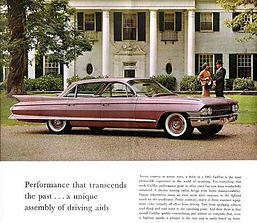


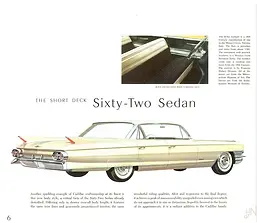


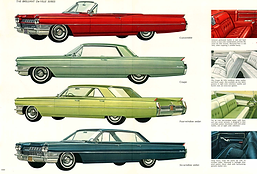
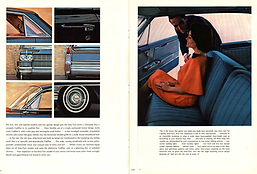


De Cadillac van 1965–1969
Mitchell wilde definitief afstappen van de laatste herinneringen aan het Harley Earl-tijdperk: de vinnen moesten verdwijnen en plaatsmaken voor haarscherp, gesneden plaatwerk met een atletische, krachtige houding.
Modeljaar 1965: Het einde van de staartvinnen
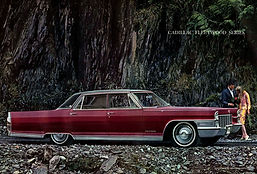
Als je de Cadillac van 1965 bekijkt, zie je de grootste visuele breuk in meer dan een decennium. Voor het eerst sinds 1948 waren de karakteristieke staartvinnen op de achterspatborden volledig verdwenen. De carrosserie werd aan de achterzijde strak en recht getrokken, wat de auto's een ongekende, tijdloze 'Sheer Look' gaf.
Aan de voorzijde maakte Cadillac een even opvallende stap: de horizontaal geplaatste dubbele koplampen maakten plaats voor verticaal gestapelde koplampen. Hierdoor oogde de grille breder en het hele front aanzienlijk imposanter en agressiever.
Onderhuids werd de verandering zo mogelijk nóg ingrijpender. Cadillac nam definitief afscheid van het X-frame dat sinds 1957 werd gebruikt. In plaats daarvan kregen alle modellen een nieuw, stijver perimeter frame. Dit zorgde niet alleen voor een veel betere botsveiligheid en een nog stillere cabine, maar maakte het ook mogelijk om de spoorbreedte te vergroten voor een superieure wegligging.
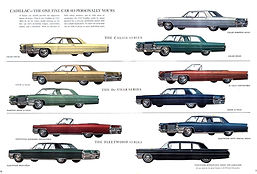
Ook in de showroom veranderde er veel. De aloude benaming Series 62, die sinds 1940 als ruggengraat van het gamma had gediend, werd gepensioneerd. Het nieuwe instapmodel kreeg de naam Cadillac Calais. De luxere De Ville-reeks, de Fleetwood 60 Special en de machtige Fleetwood 75 limousines bleven de vertrouwde pijlers. Waaribj de 75 nog de look had van 1964. Het publiek omarmde de strakke, vinloze Cadillac massaal: voor het eerst in de geschiedenis doorbrak de divisie de grens van 180.000 verkochte auto's in één modeljaar.
Modeljaar 1966: Verfijning en ergonomie
Na de grote herziening van 1965 richtte het ontwerpteam onder leiding van Chuck Jordan zich voor 1966 op verfijning. De grille kreeg een iets grovere maaswijdte en de brede chromen lijst boven de koplampen werd subtiel aangepast. Aan de achterzijde werden de verticale achterlichten strakker geïntegreerd in de achterspatborden. De Fleetwood 60 Special kreeg een nog exclusievere uitstraling met een optioneel vinyl dak dat voorzien was van een kleinschaliger, formeler achterruitje.
Mechanisch bracht 1966 voornamelijk comfortverbeteringen:
-
Variabele stuurbekrachtiging: Een nieuw stuurhuis zorgde ervoor dat inparkeren moeiteloos ging, terwijl het stuurgevoel op de snelweg aanzienlijk strakker en koersvaster werd.
-
Telescopisch verstelbaar stuur: Het Tilt-Wheel kon voortaan niet alleen in hoogte, maar ook in diepte (telescopic) worden versteld.
-
Stoelverwarming: Cadillac introduceerde optionele verwarmde voorstoelen met een koolstof-element—een primeur die zijn tijd ver vooruit was.
Ook voor de reusachtige Fleetwood Series 75 Limousine was 1966 een mijlpaal. Voor het eerst in zestien jaar kreeg de limousine een volledig nieuwe carrosserie sinds het begin van de jaren 50. Het frame was in 1957 al vernieuwd. Het model sloot nu weer naadloos aan bij de rest van het gamma.
Modeljaar 1967: De sensationele Eldorado met voorwielaandrijving
1967 gaat de boeken in als een van de belangrijkste jaren uit de geschiedenis van General Motors. Cadillac introduceerde de volledig nieuw ontworpen Fleetwood Eldorado Coupe.
Het was een auto die de wereld perplex deed staan. Ontworpen onder directe supervisie van Bill Mitchell en getekend door ontwerper Ned Nickles, combineerde de nieuwe Eldorado messcherpe, hoekige razor-edge lijnen met een lange motorkap, een hele korte achterkant en verborgen koplampen.
Maar de echte sensatie zat onder het plaatwerk:
-
Voorwielaandrijving (FWD): De Eldorado deelde het innovatieve E-body platform met de Oldsmobile Toronado. De machtige 429 CID V8 drijft de voorwielen aan via een speciaal aangepaste Turbo Hydra-Matic 425 transmissie met een kettingaandrijving.
-
Ongekende ruimte en wegligging: Door het ontbreken van een kardanas-tunnel was de vloer in het interieur volkomen vlak. Bovendien zorgde het gewicht van de motor op de aangedreven voorwielen voor een onovertroffen tractie in sneeuw en regen.
De '67 Eldorado werd een gigantische hit. De vraag was zó groot dat de fabriek de vraag nauwelijks kon bijbenen en er ruim 17.000 exemplaren over de toonbank gingen—een verkooprecord voor het model.
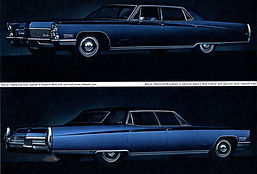
De overige Cadillac-modellen voor 1967 kregen een opvallende facelift. De motorkap werd aan de voorzijde met enkele centimeters verlengd en schuinde naar voren af, wat de auto's een dynamischer profiel gaf. Veiligheid werd een speerpunt: schijfremmen op de vooras werden leverbaar en een energie-absorberende stuurkolom werd standaard.
Modeljaar 1968: De komst van de gigantische 472 CID V8
Toen de modellen voor 1968 de showrooms binnenreden, leek er aan de buitenzijde op het eerste gezicht niet veel veranderd. De opvallendste optische wijziging was dat de motorkap langer werd gemaakt en overstak tot aan de voorruit, waardoor de ruitenwissers elegant uit het zicht werden verborgen.
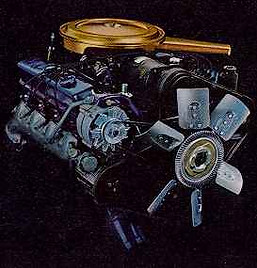
Het échte, historische nieuws voor 1968 zat echter onder de motorkap. De vertrouwde 429 V8 werd gepensioneerd en vervangen door een gloednieuwe, door Cadillac zelf ontwikkelde gietijzeren krachtpatser: de 472 CID (7,7 liter) V8. Deze motor was op dat moment de personenautomotor met de grootste cilinderinhoud ter wereld. En de cijfers spraken voor zich:
-
Vermogen: 375 pk bij 4.400 tpm.
-
Koppel: Een verbluffende 712 Nm (525 lb-ft) bij slechts 3.000 tpm.
Het blok was niet alleen beresterk, maar ook uiterst modern ontworpen. Het bevatte minder losse onderdelen, was stijver en kon moeiteloos voldoen aan de eerste strengere federale emissie-eisen zonder aan souplesse in te boeten. Bovendien was de motor bewust overgedimensioneerd; het blok bevatte genoeg 'vlees' om in 1970 te kunnen groeien naar de legendarische 500 CID (8,2 liter).
Verkooptechnisch bleef Cadillac de concurrentie van Lincoln en Imperial verpletteren. In 1968 rolden er voor het eerst in de historie meer dan 200.000 Cadillacs in één jaar van de band.
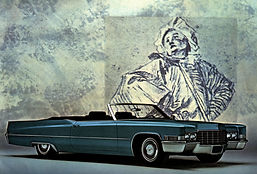
Modeljaar 1969: Terugkeer naar horizontale koplampen
Voor het laatste modeljaar van het decennium voerde Cadillac een belangrijke stijlwijziging door op de standaardmodellen. De verticaal gestapelde koplampen, die sinds 1965 het gezicht van het merk hadden bepaald, verdwenen. Cadillac keerde terug naar horizontale dubbele koplampen, geïntegreerd in een brede, fijnmazige grille.
Het ontwerp van de grille en het front werd sterk geïnspireerd op het enorme succes van de Eldorado. De spatborden staken aan de voorzijde als strakke snijvlakken naar voren.
De Eldorado zelf kreeg voor 1970 eveneens een update: de verborgen koplampen vervielen en maakten plaats voor open, vaste koplampunits.
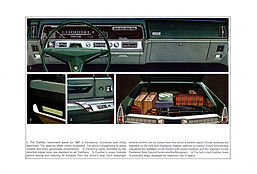
In het interieur zette de modernisering door. Het dashboard werd volledig herontworpen, waarbij alle bedieningselementen en instrumenten in een halo rond de bestuurder werden geplaatst. Ook veiligheid bleef een rol spelen: hoofdsteunen op de voorstoelen werden verplicht en het contactslot verhuisde van het dashboard naar de stuurkolom en kreeg een stuurslot.
Cadillac had de overgang van barokke overdaad naar strakke, moderne klasse feilloos doorstaan. Het merk was klaar voor de uitdagingen van de jaren zeventig.