DRIVING HISTORY, ONE MILE AT A TIME

In 1893 Edward Murphy established a carriage building factory in Michigan, USA, under the name Pontiac Buggy Company. A few years later it became clear that the future did not lie in carriages, but in cars. Edward Murphy founded the Oakland Motor Company in 1907 to be involved in the manufacture of automobiles as well. It was a time of pioneering and collaboration. In 1908, Ford introduced its T Ford, a milestone in automotive history.
Ford's great counterpart, General Motors (GM), was constantly looking for talent to find the right answer to Ford's success. A friend of Edward Murphy, William Durant, the founder of GM, was impressed by Edward Murphy and so bought half the shares of the Oakland Motor Company. This happened in January 1909. However, Murphy died unexpectedly in the summer of 1909, after which GM decided to take over the rest of the company.
The Oakland brand, now called Oakland Motors Division, grew and was quite successful. Within the GM group, Oakland had been placed just above Chevrolet and just below the premium brands Oldsmobile and Buick.
The GM concern had to contend with production and quality problems in the early 1920s. To tackle these problems, a group-wide program was set up that managed to solve the problems. The next problem that emerged within the group was that the programs of Chevrolet, Oakland, Oldsmobile, Buick and Cadillac were not well matched in terms of price. To solve this problem, Cadillac was ordered to create the LaSalle brand, Buick the Marquette brand and Oldsmobile the Viking brand. In this way the gaps between the different brands had to be closed. To close the gap between Chevrolet and Oakland, Oakland was commissioned to create the Pontiac brand. And that brand is what this article is all about.
In 1926 the time has come. From the Oakland division, GM introduces the new Pontiac brand. The public can get to know the new brand for the first time at the New York Motor Show in 1926. The first Pontiac to be presented is the six-cylinder Pontiac Chief (Pontiac Series 6-27), a six-cylinder for the price of a four-cylinder that was an immediate hit. In the first year of production, 76,742 Pontiacs were made, in the following year there are already 127,883 and Pontiac occupies sixth place in the list of best-selling brands in the US. At the end of 1927, Pontiac introduced a new series for the 1928 model year, the Pontiac Series 6-28. The logo with the silhouette of an Indian head appears for the first time on this model. This logo would remain until 1956.
In the meantime, sales are starting to gain momentum and production capacity needs to be expanded. In the state of Michigan, a new factory is being built in Pontiac. The Series 6-28 is a hit and sales continue to climb. For 1929, Pontiac introduces the 6-29 Big Six. This was actually not a new model but a Vauxhall. Not long before that, GM had taken over the English company Vauxhall. The 6-29 Big Six was the first Pontiac also available as a convertible. In 1929 the 500,000th Pontiac leaves the factory. Pontiac's future looks bright.
But then things go wrong. In October 1929, the financial market collapsed. Wall Street is on fire. A difficult time is dawning in the United States. The demand for cars, which had increased every year until the stock market crash, is collapsing. Pontiac cannot escape this either. Despite a 15% price reduction, only 62,888 of the Pontiac 6-30B are made.
In 1931 Pontiac bounces back a bit when the new Series 401 turns out to be doing well. But the Pontiacs sold in 1932, 47,926 units, suffered a loss of $125.35 each. Rumor has it that Pontiac, along with Buick and Cadillac, would be discontinued. GM won't let it get that far, though. The recession does mean the end of the Oakland brand. Since the start of the Pontiac brand, the brand has played a less and less important role. Pontiac's sales numbers are eclipsing Oakland's numbers by big numbers. In 1931, GM decided to discontinue the Oakland brand.
From 1933 Pontiac is no longer dependent on the central GM Art & Color design department for the design of its models, but Pontiac gets its own design studio. The new chief designer Frank Hershey is dissatisfied with the current models and has everything redesigned in two weeks. The result of this action was a cheap 8-cylinder, which, however, had the appearance of the much more expensive models on the market. To keep the price of the Pontiacs low, many parts are borrowed from Chevrolet, including the body. With the new 8-cylinder, Pontiac's image gets a big boost and sales are almost double digits compared to 1932, 85,348 compared to 47,926 units. With the wind at its back again, Pontiac was the first division of GM to put a car with independent front suspension into production in 1934. The sales figures continue to rise and in 1935 sales rise to 140,000 units. The increase continues in 1936 to 172,000 Pontiacs and in 1940 even 217,000 cars are built. In that year, the millionth Pontiac also leaves the factory.
In 1941 Pontiac was the first to offer buyers a choice between different engines. Production rose to 330,061 units that year.
Meanwhile, World War II was about to take on global proportions. On March 1, 1941 Pontiac starts producing an anti-aircraft gun, the Oerlikon 20 mm, for the US Navy. From 1942, American car manufacturers were obliged to use almost no more chrome. All Pontiac parts, except the bumpers, which were normally made of chrome, were now painted steel. These models, which were much less beautiful, are known as blackout models. In addition, the brand also began to produce automatic machine guns, axles for tanks, parts for diesel engines and aircraft torpedoes.
After the attack on Pearl Harbor on December 7, 1941, the United States also became directly involved in World War II. On February 10, 1942, the last pre-war Pontiac is made and the whole factory switches to war production.
Towards the end of the war it was time to return to normal production. New machines, which were to double production to 500,000, are placed in the factory. However, in December 1945, the UAW, the US auto industry union, begins a strike for more pay. It was not until 3 March 1946 that the strike was ended with a wage increase. Pontiac is also affected by the strike. The first post-war models are slightly modified models from 1942, but the demand for cars immediately after the war was so great that sales rose from 113,109 in 1946 to 206,411 in 1947.
For new Pontiac models, the public has to wait until 1949. Pontiac does introduce the Hydra-matic automatic gearbox in 1948, which is available as an option. Just before Pontiac's new post-war models go into production, spy photos revealed that Ford would come with a nearly identical radiator grille. Because the Ford models would come on the market earlier, Pontiac decided to quickly a newly designed radiator grille.
In 1950 Pontiac launched the Catalina. The Super De Luxe version of the Catalina was the most luxurious model of that period. At the same time, the brand also had the cheapest 8-in-line in the country. A production of 446,429 units was achieved in that year. The 1950s saw the rise of automatic transmissions and V8 engines and Pontiac also concentrated on the development of a V8 engine coupled to an automatic gearbox.
In 1951 production was curtailed by the Korean War and in 1952 the use of chromium was again curtailed. Sales at the time were 337,821 and 266,351 units respectively. In 1953 a new type, the Pontiac Star Chief, was launched, with optional power windows, air conditioning and power steering. In 1953, 385,692 cars were sold. Until 1955 Pontiac remains a strong brand.
In 1956 Pontiac debuts in motorsport. Ab Jenkins, 73, set a new speed record for the 24 hours with a modified Pontiac. He drove an average of 190 km/h over a distance of 4572 km. The initiative for Pontiac's participation is credited to Semon Knudsen, the brand's new manager. Knudsen had to upgrade the brand, which was known for durable and reliable but not for eye-catching cars. This was necessary because sales started to decline in 1956. Knudsen took even more steps to achieve this. Shortly before the production of the 1957 models, Knudsen had the until then characteristic radiator grille removed. He also replaced the Indian head decal that had been on all Pontiac cars since 1928. In February, the Pontiac Bonneville was launched as a top model. Only 630 copies were planned, all convertibles. The V8 delivered more than 300 hp and gave the car a top speed of 209 km/h.
Wie ontwierp de Ford van 1949?
Door Jim en Cheryl Farrell
Er is vandaag de dag waarschijnlijk meer controverse over de herkomst van het ontwerp van de Ford uit 1949 dan ooit tevoren. Ontwerpers George Walker, Richard Caleal, Bob Bourke en Bob Koto hebben in de loop der tijd allemaal wel een deel van de eer opgeëist. Anderen beweren dat het ontwerp afkomstig was van een ongebruikt of weggegooid Studebaker-ontwerp. Bourke was ervan overtuigd dat hij de iconische spinner grille (kogelgrille) voor de '49 Ford had ontworpen, gebaseerd op soortgelijke grilles die hij eerder had getekend voor Studebaker-voorstellen. Foto's van Ford lijken die specifieke kwestie rondom de grille inmiddels te hebben opgelost; het is nu algemeen geaccepteerd dat Joe Oros met de spinner grille op de '49 Ford op de proppen kwam. Vrijwel al het andere is nog altijd onduidelijk door de vele tegenstrijdige claims over wie welke kenmerken van de auto heeft ontworpen. Hopelijk zal de tijd ons meer leren.
Hier is het korte verhaal (verderop deze pagina meer verhalen hierover) van hoe het ontwerp van de '49 Ford tot stand kwam. Henry Ford II was jong en onervaren, dus werd er een doorgewinterde GM-topman genaamd Ernie Breech ingehuurd om Henry het autovak te leren. Bob Gregorie, destijds het hoofd van de designafdeling van Ford, had al twee ontwerpvoorstellen klaarliggen voor de '49 Ford die het merk op de markt wilde brengen. Toen Breech net bij Ford aantrad, dacht hij dat de kleinere Ford-auto geen geld op zou leveren. Daarom regelde hij de verkoop van dat ontwerp aan Ford France. Het grotere voorstel van Gregorie vond Breech te groot om winstgevend te zijn. Als oplossing stelde hij een ontwerpwedstrijd voor tussen Gregorie en Breechs vriend, George Walker, om nieuwe voorstellen voor de '49 Ford te ontwerpen. De auto die gekozen zou worden, zou de nieuwe '49 Ford worden.
Het kleine schaalmodel van Walker werd ontworpen door Caleal, Koto (waarschijnlijk) en Bourke (waarschijnlijk). Het uiteindelijke kleimodel op ware grootte voor de wedstrijd zelf werd echter voornamelijk gebouwd door Walker-medewerkers Joe Oros en Elwood Engel. Zij volgden in grote lijnen het kleine schaalmodel dat door Caleal, en mogelijk Koto en Bourke, was ontworpen. Het gebouwde voorstel van Walker versloeg het voorstel van Gregorie en werd zodoende de nieuwe '49 Ford. Als gevolg hiervan nam Gregorie ontslag.
Er wordt vaak gezegd dat de '49 Ford de auto was die Ford heeft gered. Of dat nu overdreven is of niet, de '49 Ford was vanaf de basis vrijwel volledig nieuw (met uitzondering van de flathead V8-motor). De productie voor het modeljaar 1949 kwam uit op 1.118.308 auto's en leverde Ford een winst op van $ 77 miljoen. Het model versloeg de verkoopcijfers van Chevrolet voor 1949 met zo'n 100.000 auto's. De '49 Ford hielp bovendien om de positie van de jonge Henry en Breech als de absolute leiders binnen Ford te verstevigen.
De foto's werden destijds tijdens de ontwerpwedstrijd gemaakt door fotografen van Ford. Ze bevonden zich in wat destijds de Ford Industrial Archives werd genoemd (tegenwoordig bekend als de Ford Archives). Veel van deze foto's zijn nooit eerder gepubliceerd. De fotograaf begon met het vastleggen van de basis-frames (armatures) waarop elk voorstel op ware grootte werd gestart. Helaas stoppen de foto's net voordat Ford-ontwerper Gil Spear de door Oros en Engel ontworpen '49 Ford klaarmaakte voor productie (en daarbij modificeerde).
George Walker


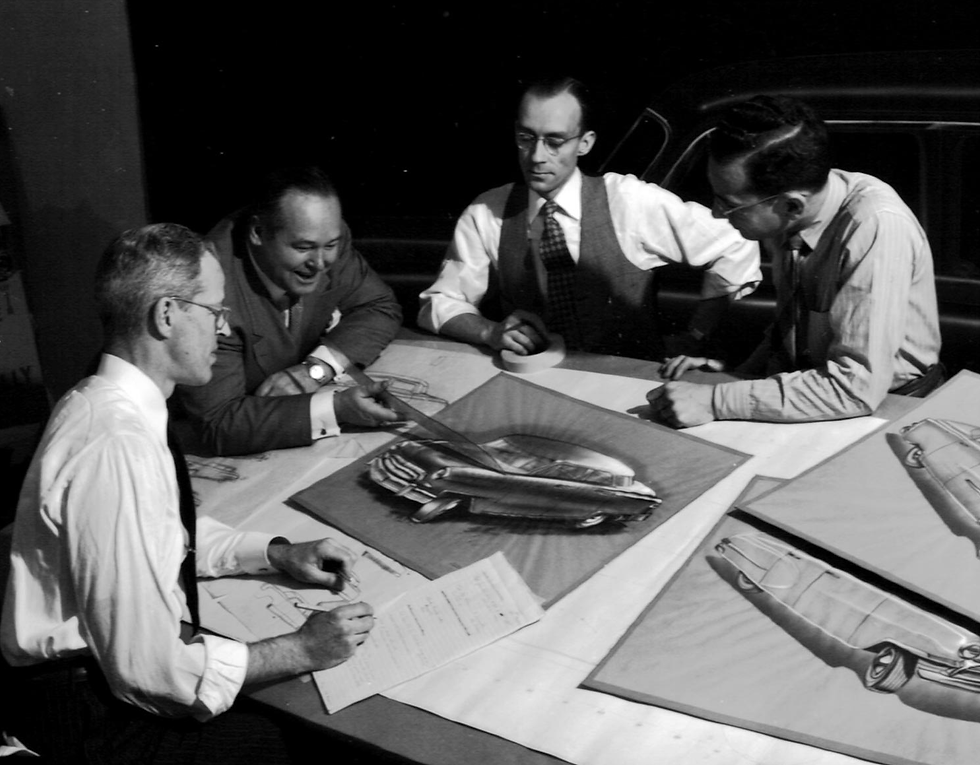
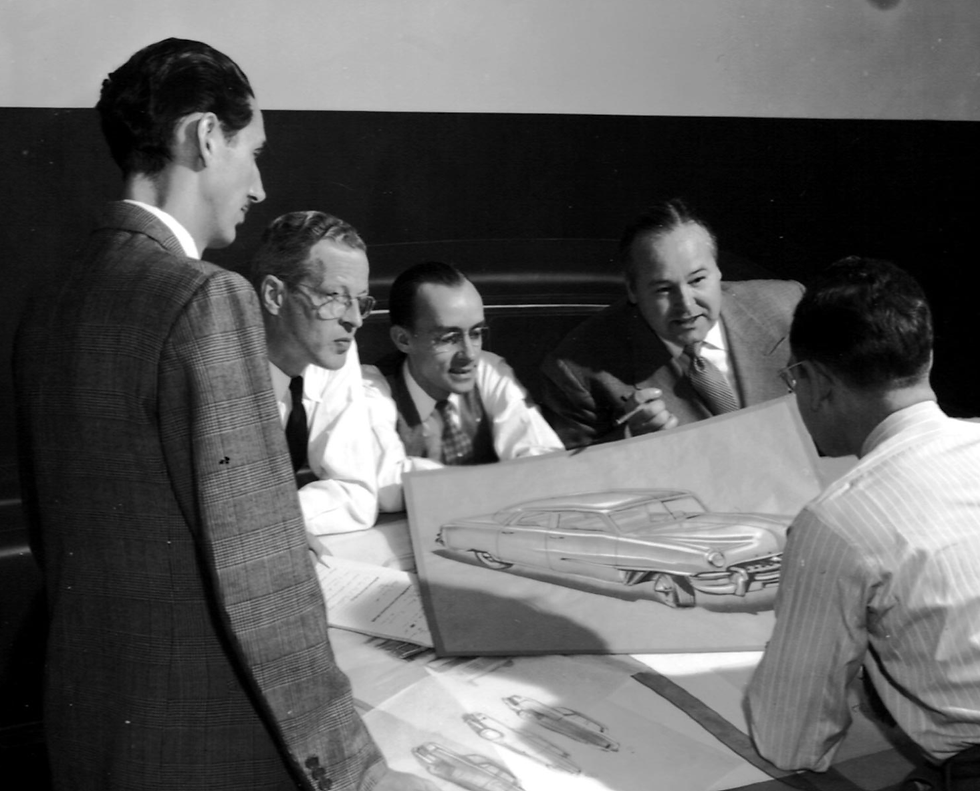


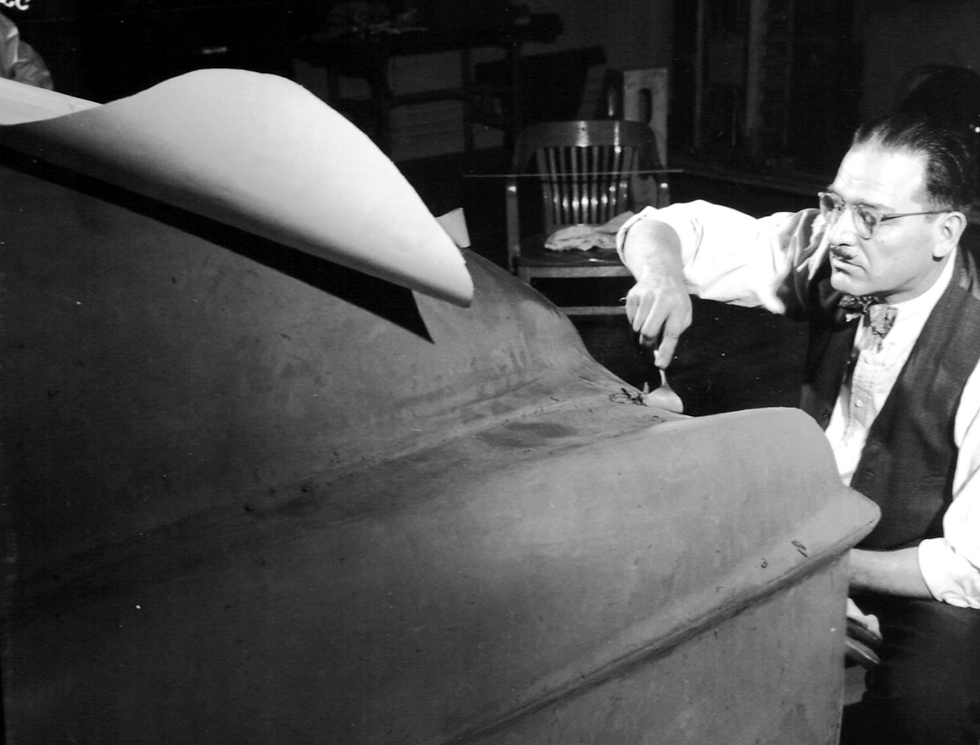


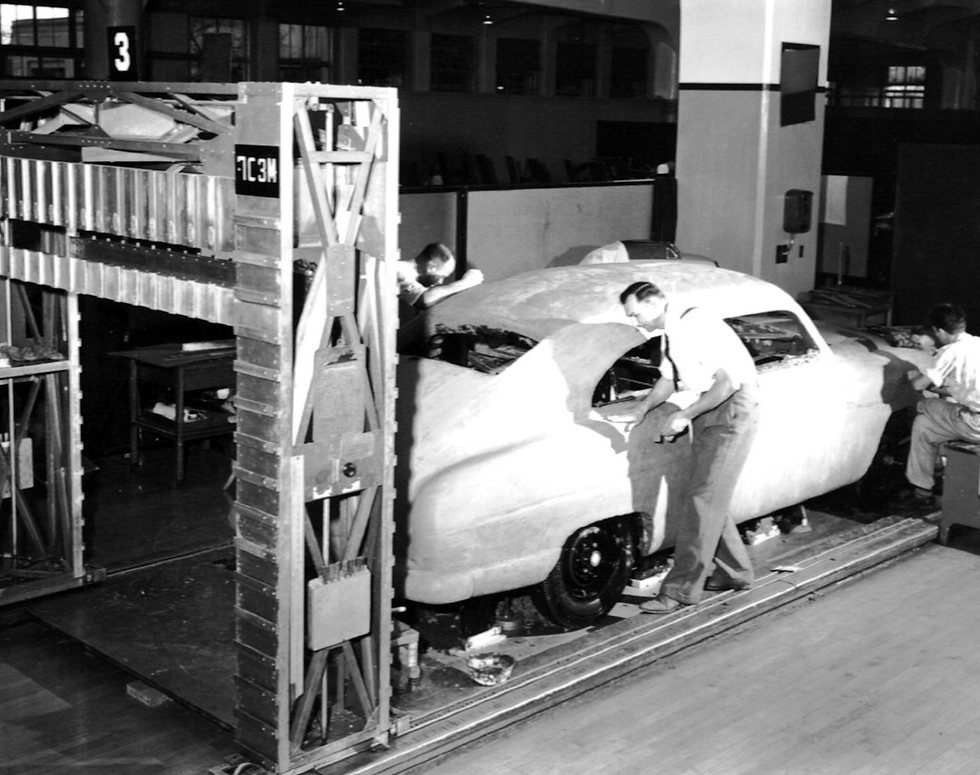


Bob Gregorie


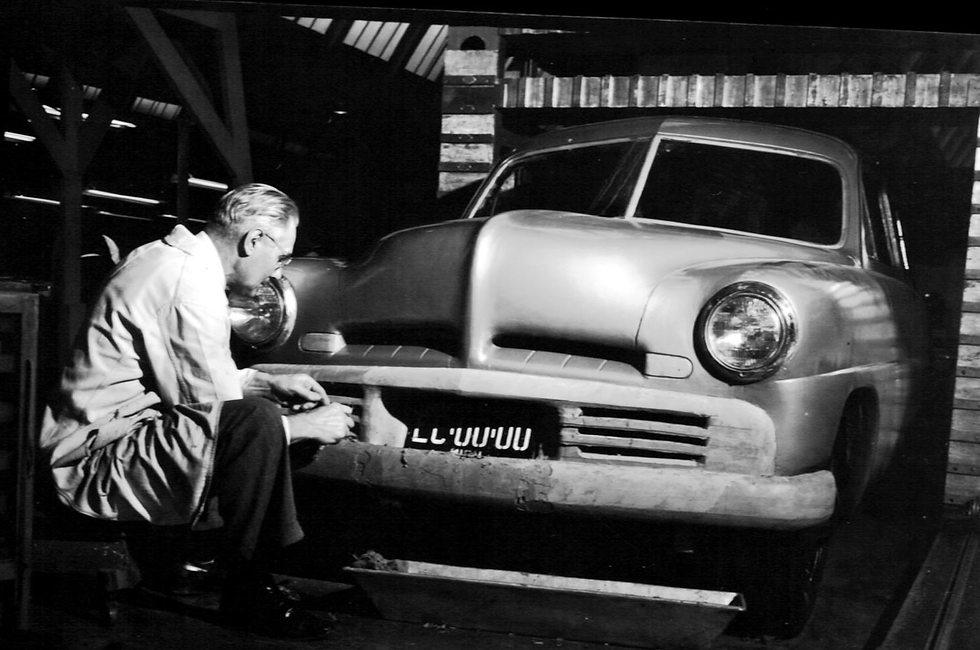


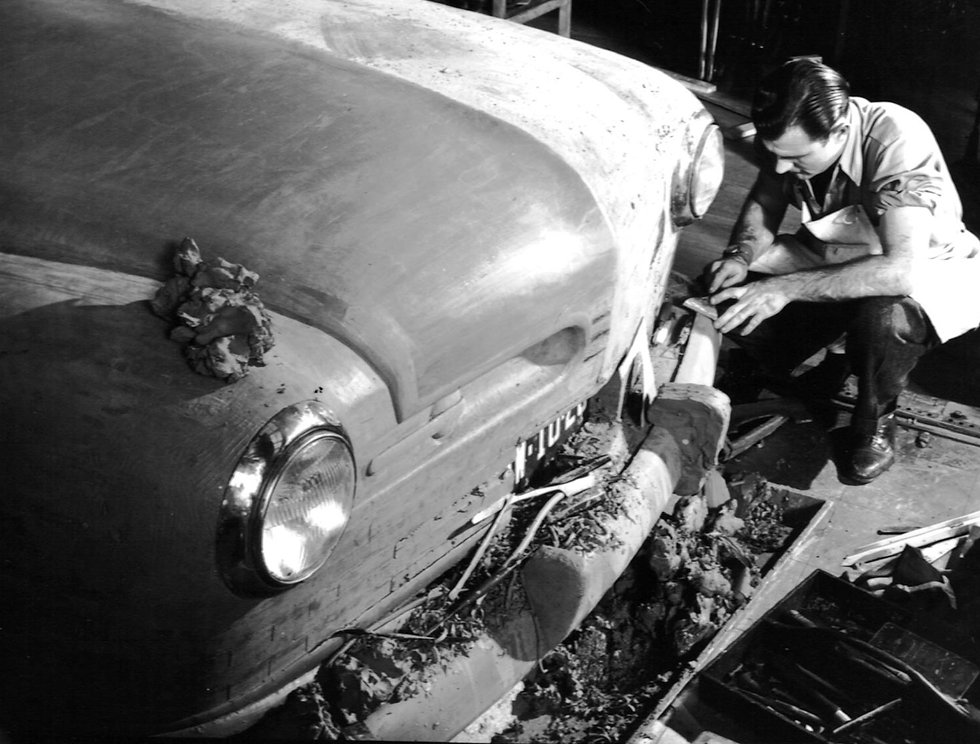


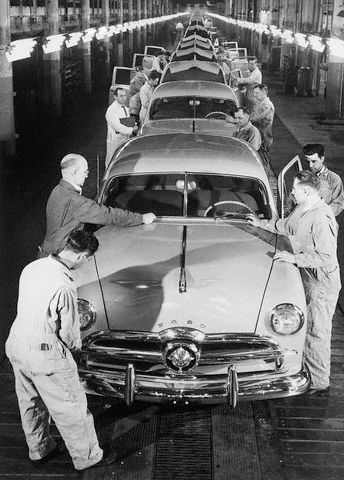


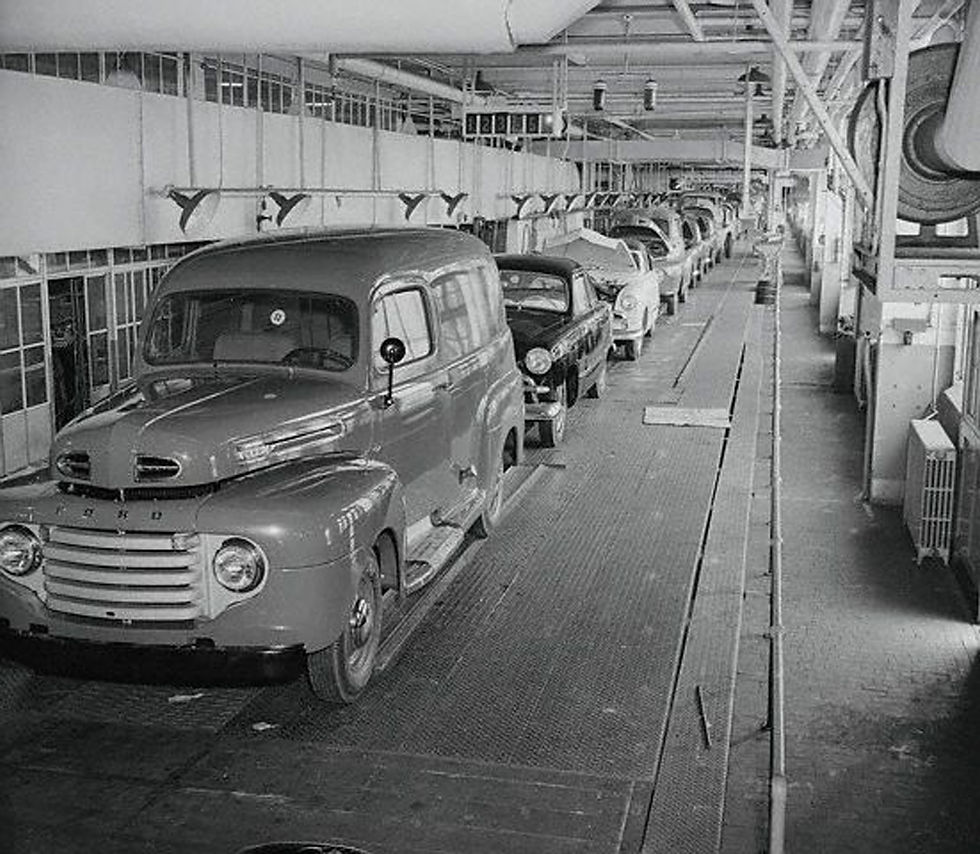



Modelreeksen: Standard, Custom en Custom Deluxe
De modelstructuur van Ford veranderde in deze jaren meerdere malen, wat soms voor verwarring zorgt.
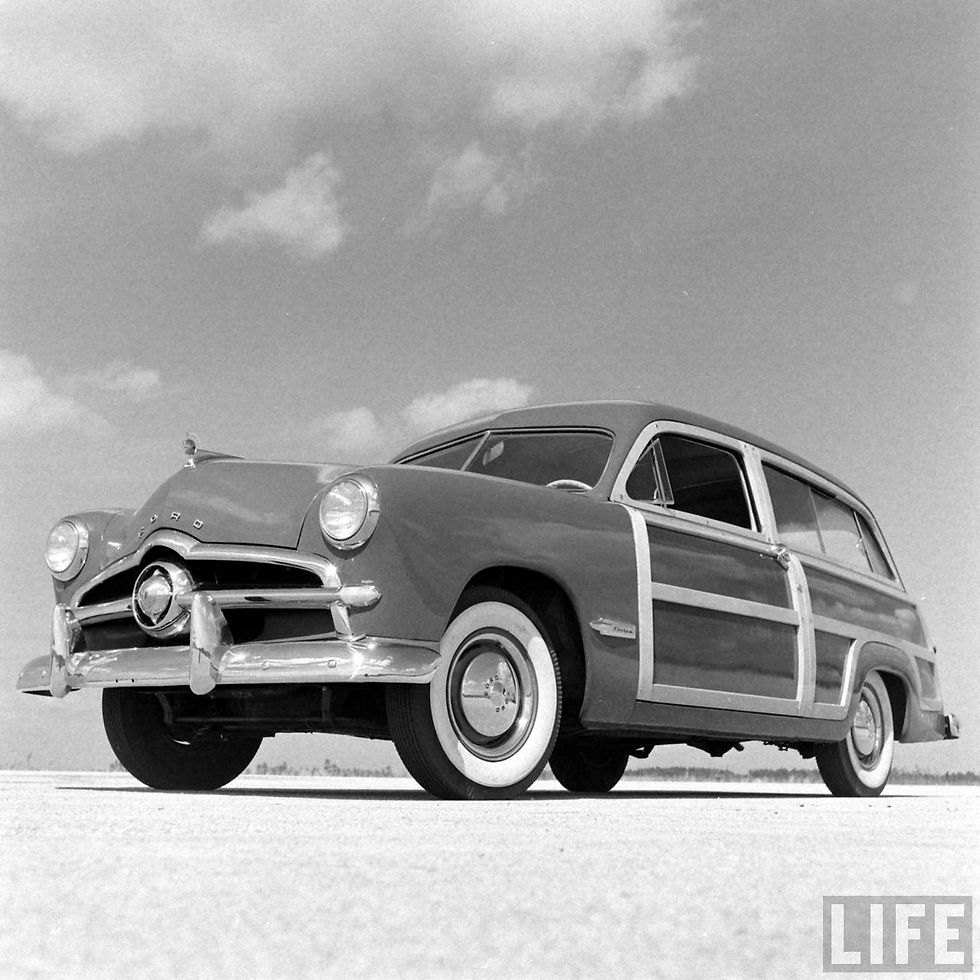
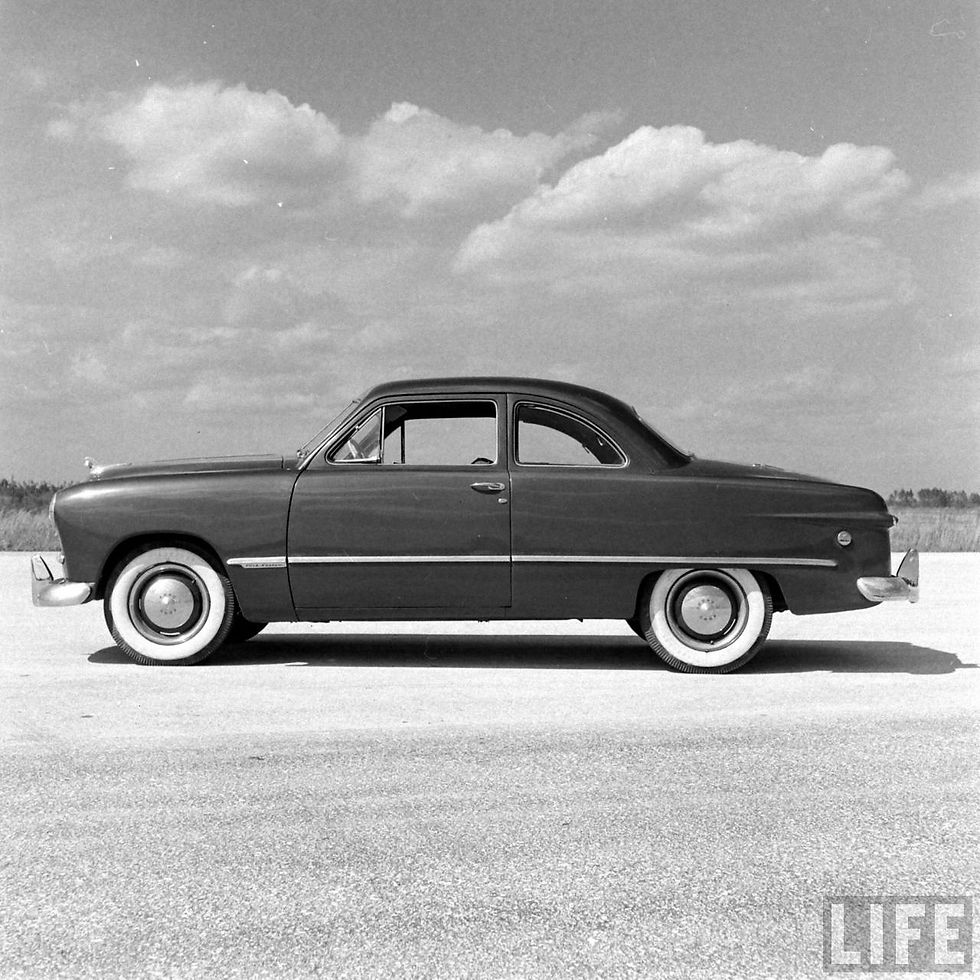
Voor 1949 werd de auto geleverd als Standard en Custom. De Standard was de eenvoudigere uitvoering, terwijl de Custom luxer was uitgevoerd en meer chroom, rijkere interieurbekleding en uitgebreidere afwerking kreeg. Ford bood diverse carrosserievormen aan: Tudor (2-deurs sedan), Fordor (4-deurs sedan), Club Coupe, Business Coupe, Convertible en Station Wagon. Sommige uitvoeringen waren alleen beschikbaar in de luxere lijn.
In 1950 wijzigde Ford de namen: de vroegere Standard werd Deluxe, terwijl de luxere uitvoering voortaan Custom Deluxe heette. Mechanisch veranderde er relatief weinig, maar de afwerking werd verfijnd en details als emblemen en grillewerk kregen een modernere uitstraling. De naam Custom Deluxe werd sindsdien sterk verbonden met de luxere Fords van begin jaren vijftig.
In 1951 bleef de basisarchitectuur gelijk, maar werden details verder verfijnd. De auto kreeg subtiele wijzigingen in sierlijsten, grille en interieur en kon voortaan met de nieuwe Ford-O-Matic automatische transmissie worden geleverd — een belangrijke stap richting het comforttijdperk van de jaren vijftig.
Technische revolutie onder de carrosserie
Hoewel de carrosserie het meest in het oog sprong, was de techniek minstens zo vernieuwend.
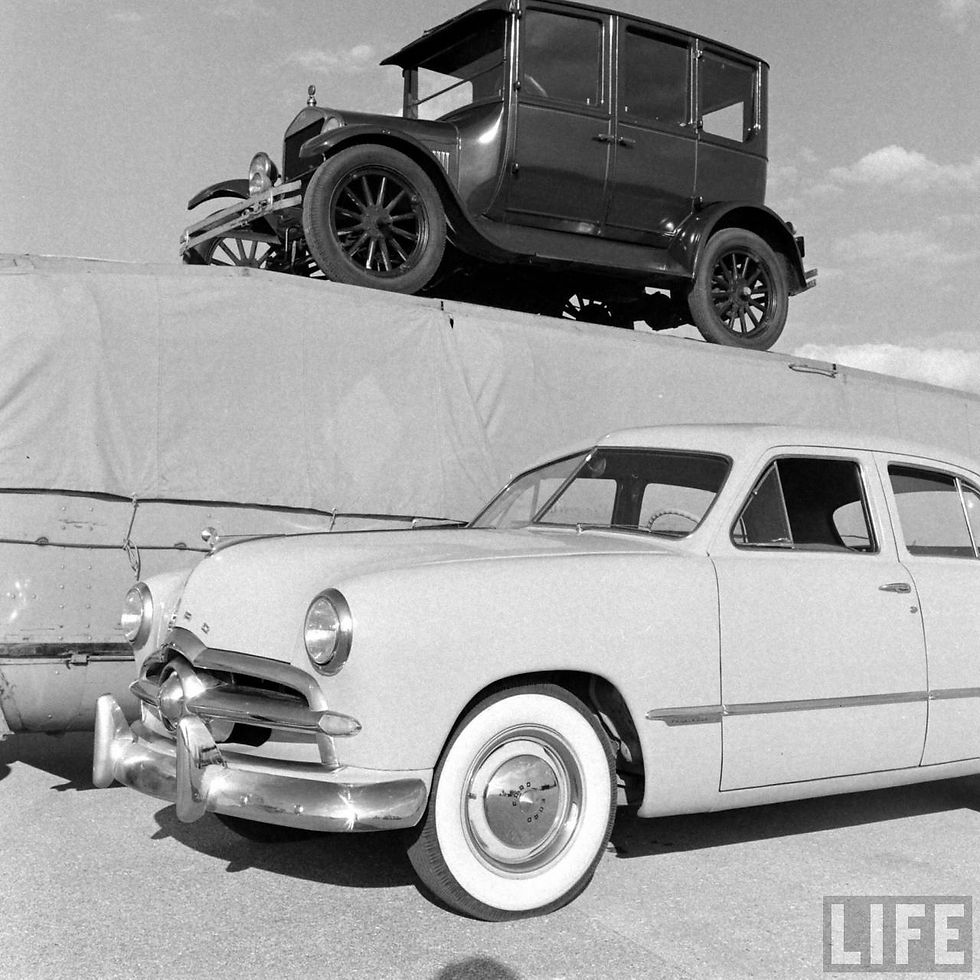
De Ford van 1949 was géén simpele facelift van het oude model. Onderhuids kreeg de auto een nieuw chassisconcept. Ford stapte af van enkele technische principes die nog teruggingen tot het tijdperk van de Ford Model T. De oude dwarsbladveren verdwenen en maakten plaats voor onafhankelijke voorwielophanging met schroefveren en modernere langsliggende bladveren achter. Ook de traditionele torque tube-aandrijving werd vervangen door een conventionele Hotchkiss-aandrijflijn met open cardanas. Hierdoor verbeterden rijcomfort, wegligging en onderhoudsgemak aanzienlijk.
Ondanks de modernisering behield Ford de wielbasis van 114 inch uit het vooroorlogse model. Daardoor bleef de auto herkenbaar als een traditionele full-size Amerikaanse sedan: groot, comfortabel en gebouwd voor lange afstanden.


De Flathead-zescilinder en Flathead V8: techniek met wortels in de jaren dertig
Onder de motorkap leefde een stuk oudere techniek voort: de beroemde flathead-motoren.
De geschiedenis begon in 1932, toen Ford een technische revolutie veroorzaakte met de introductie van de betaalbare Flathead V8. Tot dat moment waren V8-motoren vrijwel uitsluitend weggelegd voor luxeauto’s. Ford slaagde erin een V8 goedkoop in massaproductie te brengen, waardoor gewone automobilisten plotseling een achtcilinder konden rijden. De motor had een cilinderinhoud van 221 cubic inch en leverde aanvankelijk 65 pk — destijds indrukwekkend voor een betaalbare gezinsauto.
De naam flathead verwees naar de constructie van de motor: de kleppen zaten niet in de cilinderkop maar naast de cilinders in het blok (side-valve of L-head). Daardoor kon de cilinderkop vrijwel vlak blijven. De constructie was eenvoudig, robuust en goedkoop te produceren, maar had beperkingen in ademhaling en thermische efficiëntie. Toch groeide de Ford Flathead uit tot een icoon van de Amerikaanse autotechniek en later van de hot rod-cultuur.
Voor de personenauto’s van 1949–1951 leverde Ford standaard een 226 cubic inch Flathead zes-in-lijn (3,7 liter), een rustige en betrouwbare motor met veel trekkracht onderin. Wie meer prestige en soepelheid wenste, koos voor de 239 cubic inch Flathead V8 (3,9 liter), die bekendstond om zijn karakteristieke geluid en ontspannen vermogensafgifte. Op het frontembleem van de auto stond zelfs een klein “6” of “8”, zodat direct zichtbaar was welke motor onder de motorkap lag. De V8 bleef populair ondanks de komst van modernere kopklepmotoren van concurrenten. Pas in 1954 verving Ford hem door de modernere overhead-valve Y-block V8. Daarmee eindigde een motorfamilie die ruim twintig jaar een begrip was geweest.


1950: de bijzondere Crestliner
Een van de opvallendste varianten was de Ford Crestliner, geïntroduceerd in 1950. Dit model was bedoeld als sportief-luxe uitvoering om te concurreren met opvallende tweekleurige modellen van concurrenten. De Crestliner was gebaseerd op de Tudor sedan en kreeg een contrasterend vinyl dak, tweekleurige lak en extra sierwerk. Daarmee vormde hij een voorbode van de flamboyante styling die de jaren vijftig zou gaan domineren. Belangrijk is dat de Crestliner (1950–1951) niet verward moet worden met de Crestline, een andere modelserie die Ford pas vanaf 1952 introduceerde. Een groot succes was het niet met nog geen 17.000 verkochte exemplaren.
1951: de elegante Victoria hardtop
Voor veel liefhebbers vormt de Victoria het hoogtepunt van deze generatie. In 1951 introduceerde Ford de Victoria hardtop coupe, een carrosserievorm zonder vaste B-stijl die de elegante uitstraling van een cabriolet combineerde met het comfort van een gesloten auto. Wanneer de zijruiten werden neergelaten ontstond een vrijwel open profiel, iets wat perfect aansloot bij de glamourcultuur van het vroege jaren-vijftig Amerika.
De Victoria werd leverbaar als Custom Deluxe Victoria en groeide uit tot een van de meest begeerde uitvoeringen van de Shoebox Ford. Tegenwoordig behoren goed gerestaureerde Victoria’s tot de populairste modellen onder verzamelaars, mede dankzij hun harmonieuze proporties en stijlvolle daklijn.
De Ford die de jaren vijftig aankondigde
Terugkijkend markeren de modellen van 1949, 1950 en 1951 een fundamentele overgang in de geschiedenis van Ford. Ze combineerden moderne naoorlogse styling met vertrouwde techniek uit de jaren dertig, en vormden zo een brug tussen twee autowerelden: de robuuste, mechanisch eenvoudige vooroorlogse Ford en de steeds luxere, gladdere en krachtigere Amerikaanse auto van de jaren vijftig. De 1949 Ford bracht niet alleen nieuwe carrosserievormen en modernere rijeigenschappen, maar gaf Ford ook opnieuw vertrouwen, winstgevendheid en een duidelijke richting voor de toekomst.


Stunten met de shoeboxes
De Ford V8-jaren van de Joie Chitwood Thrill Show (1948–1953)
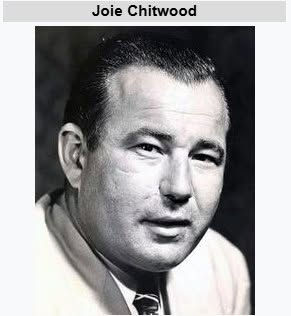
De zakelijke en operationele samenwerking tussen Ford Motor Company en stuntrijder George "Joie" Rice Chitwood (1912-1988) vormde een belangrijk hoofdstuk in de promotie van de nieuwe naoorlogse Fords. George Rice "Joie" Chitwood was een Amerikaanse coureur en zakenman, die het meest bekend werd door zijn waaghalzen-acts in de Joie Chitwood Thrill Show. De samenwerking begon tijdens de Cook County Fair op Soldier Field in Chicago in 1948. Als demonstratie van de nieuwe '49er Ford springt een witte Shoebox met exact 42 mijl per uur (ca. 68 km/u) van een houten schans, vliegt 15 meter door de lucht over een andere rijder heen en landt veilig aan de overzijde.
De totstandkoming van de deal
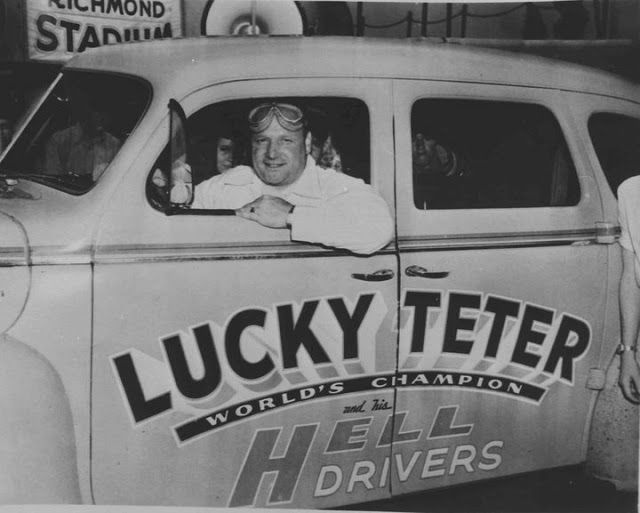
Chitwood, een succesvol coureur met zeven starts in de Indianapolis 500, kocht in 1943 de show van Earl 'Lucky' Teter nadat Teter in 1942 tijdens een stunt dodelijk verongelukte. Nadat Teter's echtgenote er in oorlogstijd niet in slaagde om het materiaal van de show te verkopen, nam Chitwood het over en maakte er zijn eigen show van. De Thrill Show was zo succesvol dat hij het racen terugschroefde en zich meer ging richten op het entertainen van het publiek.
Omdat autoraces tijdens de Tweede Wereldoorlog waren verboden maar thrillshows wel mochten doorgaan, bouwde Chitwood de show uit met strakke regie en professionele coureurs.
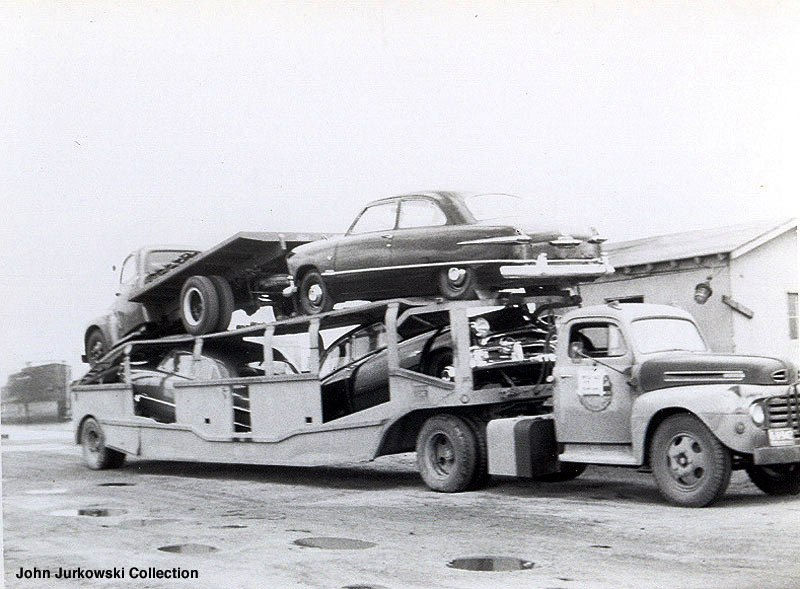
In het voorjaar van 1948 regelde Chitwoods omroeper, Bill McGraw, een afspraak met Henry Ford II. Dat leidde tot een meerjarige sponsordeal. Ford leverde fabrieksnieuwe auto's, transportvoertuigen voor het materieel en de financiële middelen om de operatie op te schalen. Er werd een speciale overkoepelende corporatie opgericht om het zakelijke beheer en de boekingen van de shows te stroomlijnen.
Technische aanpassingen aan de Shoeboxes
Hoewel de Fords in de communicatie als standaard 'stock'-auto's werden gepresenteerd, voerde het team enkele specifieke technische en veiligheidsaanpassingen door:
-
De auto's werden uitgerust met zwaardere schokbrekers (heavy duty shocks) om de klappen van de landing op te vangen.
-
Bij de auto's die voor schanssprongen werden ingezet, werd een stalen plaat aan de achterzijde onder het chassis gelast om doorbuigen bij de landing te voorkomen.
-
De benzinetanks werden verplaatst naar de kofferbak om de kans op brand bij een crash of T-bone-aanrijding te verkleinen.
-
Op het dashboard werd extra verlichting gemonteerd bij de snelheidsmeter. Omdat een sprong vereiste dat de auto met exact 42 MPH de schans verliet, moest de bestuurder in één oogopslag de snelheid kunnen aflezen.
Schaalvergroting en media
De formule bleek een commercieel succes. Chitwood en zijn stuntrijders — vaak "Hell Drivers" genoemd — hadden vijf tourneegroepen (units) die meer dan veertig jaar lang door Noord-Amerika en Canada trokken en zowel grote steden als kleine dorpen trakteerden op spektakel. Elke unit beschikte over:
-
10 tot 12 gloednieuwe Fords (oudere Fords werden ingezet als slopers/crash-auto's);
-
2 motorfietsen;
-
1 clownswagen;
-
14 tot 17 personeelsleden.
De naamsbekendheid van het team leidde in 1950 tot een uitnodiging van MGM-regisseur Clarence Brown. Voor de speelfilm To Please a Lady (met Clark Gable en Barbara Stanwyck) werd op een studio-lot een kermislocatie nagebouwd. Gedurende 15 draaidagen werden actie- en stuntscenes gefilmd waarin de 1949 en 1950 Fords zevenenhalve minuut lang centraal stonden.
Waarom Henry Ford II instemde
In 1948 stond Ford onder leiding van de jonge Henry Ford II. Het merk moest dringend af van het wat stoffige image van opa Henry Ford. De introductie van de 'Shoebox' in 1949 was een 'alles-of-niets'-gok voor het bedrijf. Ford wilde bewijzen dat het nieuwe onafhankelijke voorwielophangingssysteem (met schroefveren in plaats van de oude dwarsgeplaatste bladveren) even sterk was als het oude, starre systeem. De stuntshows van Chitwood dienden als een live, reizende demonstratie van de carrosseriestijfheid van de 'Shoebox'—als het koetswerk een landingsklap van 15 meter kon opvangen zonder te ontwrichten, kon het alles aan.
Gratis reclame op lokaal niveau
Een belangrijk onderdeel van de overeenkomst dat in de tekst niet staat, is de rol van de lokale Ford-dealers. Wanneer een van de vijf Chitwood-units een stad aandeed, zorgde Ford ervoor dat de plaatselijke Ford-dealer de kaarten verkocht en advertenties plaatste. Na afloop van een show werden de (licht beschadigde of reservewagens) vaak via diezelfde lokale dealers met korting verkocht als "geteste en goedgekeurde" auto's, wat voor de dealers extra klandizie opleverde.
"Thrill-testing" als marketingterm Ford gebruikte het beeldmateriaal van Chitwoods shows actief in hun eigen brochures en krantenadvertenties onder de noemer Thrill-Tested. Ford-verkopers kregen de instructie om twijfelende klanten te herinneren aan de sprongen die ze op de kermis hadden gezien: "Als hij de 15-meter sprong van Joie Chitwood overleeft, is hij veilig genoeg voor uw gezin."
Einde van de samenwerking
In 1953 kwam er een einde aan de vijfjarige overeenkomst. De beheermaatschappij had de shows overboekt en het organisatorische netwerk te ver uitgerekt, tot onvrede van Chitwood. Na een juridische strijd verbrak Chitwood de banden met de corporatie en zette hij de show zelfstandig voort met één touring-unit.
Hij sloot vervolgens een deal met Chrysler voor het gebruik van Plymouths. Toen Chitwood in 1954 overstapte op Plymouth, bleek dat niet alleen een technisch probleem, maar ook een commercieel drama. De Plymouths uit 1954 hadden nog een verouderde zijklep-zes-in-lijn (Flathead 6) die simpelweg te weinig acceleratie had om op korte kermisbaantjes snel genoeg de 42 MPH te halen voor de sprong. De Ford Flathead V8 uit de Shoebox had die trekkracht onderin wél. Chrysler stopte bovendien al na één seizoen met de financiële steun omdat het publiek niet warm liep voor de stijvere Plymouths. Na één seizoen stapte Chitwood over naar Chevrolet, dat in 1955 net hun nieuwe Small-Block V8 op de markt had gebracht.
Van Schoenpoetser tot Stuntlegende: Het Verhaal van George "Joie" Chitwood
George Chitwood werd geboren in Denison, Texas. Nadat hij op 14-jarige leeftijd wees werd, stopte zijn schoolloopbaan na de 'eighth grade' (het eerste jaar van de middelbare school). Tijdens de Great Depression en de zware Dust Bowl-periode woonde hij in Topeka, Kansas, waar hij hard moest werken om te overleven. Hij verdiende zijn geld hoofdzakelijk als schoenpoetser en als candy butcher (snoepverkoper) bij een burlesque-show. Daarnaast begon hij het vak van lasser te leren in een lokale werkplaats.
Het Ontstaan van de Nickname "Joie"
De bijnaam "Joie" dankte Chitwood aan een fout van een krantenjournalist. De verslaggever verstond zijn naam verkeerd en haalde "George" door elkaar met St. Joe, Missouri (de plaats waar Chitwoods eerste raceauto werd gebouwd). Bij het zetten van het artikel werd per ongeluk een "i" toegevoegd, waardoor er "Joie" kwam te staan. De naam bleef de rest van zijn leven bij hem.
De Racecarrière van Joie Chitwood (1934–1950)
Chitwood bouwde zijn allereerste raceauto zelf op basis van een oude Essex. Toen de beoogde coureur niet kwam opdagen, stapte hij zelf achter het stuur en eindigde direct als tweede.
De Beginjaren en de Sprint Cars
-
1934: Officieel debuut op een dirt track in Winfield, Kansas.
-
1937 & 1938: 2e plaats in de eindstand om het kampioenschap van de Central States Racing Association (CSRA).
-
1939 & 1940: Overstap naar het American Automobile Association (AAA) East Coast Sprint Car-kampioenschap.
-
1942: CSRA-kampioen met een recordreeks van 14 opeenvolgende overwinningen op hoofdraces (features).
-
1946 & 1947: In 1946 won hij zes grote sprint car-races. In 1947 pakte hij negen AAA East Coast-overwinningen, waaronder de allereerste race op de beroemde Williams Grove Speedway.
Tussen 1940 en 1950 nam Chitwood zeven keer deel aan de beroemde Indianapolis 500.
-
Beste resultaten: Drie keer eindigde hij op de 5e plaats.
-
WK Formule 1-punt: Omdat de Indy 500 van 1950 tot 1960 meetelde voor het officiële FIA World Drivers' Championship, staat Chitwood met zijn 5e plaats in de Indy 500 van 1950 officieel te boek met 1 Formule 1-WK-punt.
Pionier in Veiligheid: De Autogordel
Tijdens de Indianapolis 500 van 1941 werd Chitwood de allereerste coureur ooit die met een veiligheidsgordel reed. Hij had de gordel uit zijn dirt car gesloopt, niet zozeer vanwege de veiligheid, maar omdat hij minder heen en weer geschud werd en daardoor zijn voet beter op het gaspedaal kon houden. Omdat coureurs in die tijd dachten dat 'uit de auto geslingerd worden' veiliger was bij een crash, moest hij de AAA-officials Rex Mays en Wilbur Shaw beloven dat hij de gordel los zou maken als hij zou crashen.
De Geboorte van de Joie Chitwood Thrill Show
In 1942 kwam stuntlegende Lucky Teter om het leven. Teters weduwe vroeg Chitwood om het materiaal van de show te verkopen. Omdat er tijdens de Tweede Wereldoorlog geen koper te vinden was, besloot Chitwood het materiaal zelf te behouden.
Chitwood werd afgekeurd voor militaire dienst (status 4-F) en gaf tijdens de oorlog les in lassen in fabrieken. Ondertussen zette hij de show voort onder de naam The Joie Chitwood Thrill Show. Omdat het entertainmentconcept zo enorm aansloeg, besloot hij in 1950 definitief te stoppen met professioneel racen.
'Hell Drivers' en 'Chief Wahoo'
Chitwood bouwde de show uit tot vijf afzonderlijke touring-units die meer dan 40 jaar lang door heel Noord-Amerika trokken.
-
Chief Wahoo: Vanwege zijn wat donkere teint trad Chitwood regelmatig op als het personage 'Chief Wahoo', een zogenaamde Native American-krijger (hoewel hij in werkelijkheid geen inheemse herkomst had).
-
Stunts op Twee Wielen: Chitwood nam de beroemde ramp-to-ramp jump over van Teter en perfectioneerde later samen met zijn zoon Joie Jr. het rijden op twee wielen (two-wheel skiing).
-
Televisiedebuut: In januari 1967 werd hun optreden op de Islip Speedway in New York landelijk uitgezonden in het populaire programma Wide World of Sports op ABC.
Hollywood en Media-optredens
Chitwood en zijn zonen gaven het stuntwerk een gezicht in de Amerikaanse popcultuur:
-
To Please a Lady (1950): Chitwood coördineerde en reed de stunts in deze autosportfilm met Clark Gable en Barbara Stanwyck.
-
Live and Let Die (1973): Voor deze James Bond-film regelde en voerde Chitwood de voertuigstunts uit. Hij had tevens een kleine rol op het scherm als 'Charlie', de taxichauffeur die Bond ophaalt op de luchthaven JFK en door 'Whisper' wordt neergeschoten.
-
Karakteristieke optredens: De show was te zien in de tv-serie CHiPs (seizoen 3, aflevering "Thrill Show") en in de film Smokey and the Bandit Part 3 (1983).
-
Inspiratiebron: Niemand minder dan stuntlegende Evel Knievel gaf aan dat het zien van de Chitwood-show in zijn geboorteplaats Butte, Montana, zijn directe inspiratie was om waaghals te worden.
-
Dusty Russell: De wereldkampioen auto dive bomber begon zijn 50-jarige carrière in 1951 op 15-jarige leeftijd bij Chitwood.
Generaties en Wereldrecords
Na de pensionering van Joie Chitwood namen zijn zonen Timmy en Joie Jr. (geboren in 1944) de leiding over. De show bleef in touring-vorm bestaan tot 1998 (1945–1998).
-
Wereldrecord (1978): Op 13 mei 1978 vestigde Joie Jr. een officieel wereldrecord door in een Chevrolet Chevette over een afstand van 5,6 mijl (9,0 kilometer) op slechts twee wielen te rijden.
-
Derde generatie: Kleinzoon Joie Chitwood III (geboren in 1971) zette de familietraditie voort in de autosportwereld en werd in 2010 president van de beroemde Daytona International Speedway.


Foto set van de Joie Chitwood Auto Daredevils / Hell Drivers




De 1949 Ford: Ontwikkeling en Ontwerp
(Fragmenten uit het interview met George W. Walker, april 1985)
Link 1: Klik hier
Link 2 : Klik hier
Walker: [...] En toen kwam jonge Henry [Ford II] aan het roer, dat was in '46. Breech zei toen: "We willen dat je hiernaartoe komt om ergens naar te kijken." Hij zei: "We weten dat je Nash en International Harvester als klant hebt, en dat het onethisch is om dit te doen, maar vertel het aan niemand. Ik wil dat je dit doet voor Mr. Ford" — jonge Henry. "Dus, wil je hiernaartoe komen en naar deze auto kijken?"
Ik keek ernaar en zei: "Mijn hemel, dat is vreselijk. Hier ga je aan failliet." En Henry zei: "Nou, die gaan we wel op de markt brengen." Waarop ik zei: "Doe dat niet."
Q: Waar keek je naar?
Walker: De Mercury — een Mercury die een [Ford-]ontwerper uit die tijd had gemaakt... Bob Gregorie. Bob had dat gedaan, en het was een groot, oud, zwaar ding. Het was helemaal uit verhouding. Het leek op de 'zwangere Buick' van jaren geleden. [...] Ik wist niet dat Gregorie dat gemaakt had. Dat maakte ook niet uit, ik kende Gregorie niet eens. Dus ik zei: "Dat kun je niet op de markt brengen." Hij vroeg: "Kun jij het beter?" Ik zei: "Dat kan ik nog beter met mijn ogen dicht."
Hij zei: "Neem je de opdracht?" Ik zei: "Nou, nee. Ik moet eerst Nash zien te lozen als ze dat willen, en ook International Harvester..." [...] Breech zei toen: "Dat is een geweldige kans. Ik kan je niet vertellen wat er gaat gebeuren, maar je kunt miljoenen verdienen door met ons mee te doen." [...]
Ik zei: "Nou, ik doe het. Maar jullie moeten elke keer dat ik bel langskomen om het werk te beoordelen, want we hebben geen tijd, we zitten aan een deadline." Dus we haalden alles overhoop en zetten onze hele organisatie in — 27 man personeel.
Walker: We kwamen op het punt dat we de presentatie gaven. Ze kwamen naar beneden voor de presentatie nadat het model in klei klaar was, en ze zeiden: "Dat is 'm. Dat is 'm."
Q: Had je een schaalmodel op 3/8e of een kwartgrootte?
Walker: Een schaalmodel op 1/8e grootte. Daarna gingen we over op een kwartgrootte om het wat beter te shapen. En daarna het model op volle grootte.
Het model op volle grootte maakten we daar bij de fabriek op de ontwerpafdeling. Er hoorde dag en nacht een bewaker te staan — twee bewakers, één voor elk uur van de dag. Niemand mocht naar binnen. [...]
Toen ze zagen hoe het onze geworden was en het bedrijf die kant op neigde... wilden ze het in het groen hebben. Dat is ook zoiets. Groenblauw. Het ontwerp van Gregorie was groenblauw. [...] Ik zei: "Nee, dit wordt geelachtig beige." — "Oh, maar dat vindt Mr. Ford niet mooi." Ik zei: "Dit is niet zíjn auto. Het is míjn auto. Totdat hij hem koopt." [...]
We spoten het in die kleur: beige met veel wit erin, en een helder geel. De auto zag er zo mooi uit, helemaal voorzien van glas, gespoten en met al het beslag. Toen ze het zagen, keurde iedereen het voor 100% goed. Zelfs Youngren.
Q: Wie waren er aanwezig bij die bijeenkomst?
Walker: [Meade] Bricker, Jack Davis, Harold Youngren, Benson Ford, Henry [II] en Breech. [...] Ze keken naar de schetsen en zeiden: "Dat is goed." Toen keken ze naar het voltooide kleimodel op schaal 1/4 en zeiden: "Dat is 'm." [...]
Toen we het model op volle grootte klaar hadden, hadden we nog een bijeenkomst voor de definitieve goedkeuring met hetzelfde bestuur. Ze liepen allemaal rond de auto. Eerst lieten we hem zien aan de oude heer — Mr. Henry Ford [I] — en hij pakte de deurklink vast (die alleen vastgeplakt zat in de klei), hij trok hem eraf, gooide hem op de grond en zei: "Dat werkt niet." Ze lachten en lachten. En nadat ze klaar waren, kwam het bestuur binnen en keurde het goed.
Q: En dat was de '49 Ford?
Walker: Dat was de '49 Ford. Daarna begonnen we met het maken van alle technische tekeningen en schetsen op volle grootte.
Q: Dat was in 1946?
Walker: 1946. En de matrijzen/mallen werden aan het eind van '46 gestart. Het was een spoedprogramma, een crashprogramma.
Q: Vertel eens over de verhalen... Joe Oros praat over de 'spinner'-voorkant waaraan hij heeft gewerkt.
Walker: [...] Joe [Oros] en Elwood [Engel] hebben het gedaan. [...] Het had niets met de voorkant te maken [verwijzend naar Dick Calleal] — helemaal niets. Maar Joe wel, dat was Joe's type spinner.
Op een gegeven moment hadden we de kamer vol hangen met schetsen van alleen de spinners voor de voorkant. De spinner-stijl beviel mij wel, en Breech vond het ook mooi. Hij kwam op een dag langs, speciaal voor de presentatie van de voorkant. Hij bracht James Melton mee [een bekende zanger]. Ik zei tegen Melton: "Ze zoeken een voorkant," en hij wees aan: "Die vind ik mooi." Dat was de spinner.
En kort daarna keek Henry [II] ernaar, en Jim Melton zei: "Hey, dit is goed." Waarop Henry zei: "Ik vind het ook mooi."
Q: Wie waren de belangrijkste assistenten die aan de '49 Ford werkten?
Walker: We hadden destijds ongeveer 14 mensen op ons kantoor die aan het begin het werk deden — Hopkins, Calleal, Oros, Ornes en Bob Koto. En toen we bij Ford de volle grootte gingen doen, gaven zij ons een paar van hun kleimodelleurs om het af te maken op volle grootte.
Elwood [Engel] superviseerde het tot op zekere hoogte, hij en Joe Oros hadden de leiding. Dat was hun auto. Ik noemde het hun auto, en iedereen daar noemde het hun auto. We gaven hen er de credits voor.
Walker: De matrijzen werden dus eind '46 gestart. Wij moesten toezicht houden om te zorgen dat alles goed verliep. We hadden drie ingenieurs die erg goed waren en nauw met ons samenwerkten om te zorgen dat we niet van het pad afraakten.
Een van hen was Charlie Blanton, de hoofd-carrosserie-ingenieur. Hij kwam dan naar ons toe en zei: "Als we de daklijst/regenloop zo maken, schaadt dat jullie ontwerp?" En dan zeiden wij: "Nee." "Doe het dan zo, want dat bespaart geld." Of: "Hoe zit het met de naad van de motorkap? Als we dit doen, kunnen we hem daar niet buigen..." — "Nou, dat is goed, maak het maar zoals jullie willen."
We werkten hand in hand. Dat hadden ze bij Ford nog nooit meegemaakt. Vroeger waren ze daar heel hautain over: de ingenieur wilde iets doen en niemand kon hem wat anders vertellen.
Q: Herinner je je iets van de ontvangst van de auto?
Walker: De ontvangst van dit hele verhaal was echt geweldig. De pers was erbij. [...] Ze hielden die avond een banket. Youngren stond op en vertelde dat dit een geweldige auto zou worden en dat het de grote verdienste was van Mr. Oswald.
Breech zat er zo bij [kijkt bedenkelijk], stond meteen op en zei tegen de pers: "Ik wil één ding rechtzetten. Deze auto is vormgegeven door George Walker en zijn staf, en vergeet dat niet! Ik wil niet dat iemand dat vergeet." Dat was erg goed. Anders toegeschreven aan Oswald en Youngren, terwijl Oswald er absoluut niets mee te maken had.
Q: En de auto was een groot succes, en je won een modeprijs?
Walker: Ik won er de modeprijs (Fashion Academy Award) mee. En Mr. Ford was er erg erkentelijk voor. Daarna wees hij er altijd op dat ik de 1949 Ford had gedaan.
George W. Walker en de Ford van 1949
In 1945 kwam George W. Walker via Ernest R. Breech in contact met Ford. Breech was kort daarvoor bij Ford gekomen vanuit General Motors en wilde Walker aantrekken voor het ontwerp van de nieuwe naoorlogse Ford.
Walker vertelt:
"Op een dag kwam Breech mijn kantoor binnen en vroeg: 'Wat zou je ervan vinden om de Ford-opdracht te krijgen?' Hij was net bij Ford begonnen. Ik zei dat ik dat graag zou willen en dat ik hem al het werk kon laten zien dat ik jarenlang voor Ford-leveranciers had gedaan, hoewel ik de Ford-opdracht zelf nog niet had."
Walker had eerder al via Ford-verkoopmanager Jack Davis een presentatie voorbereid die aan Henry Ford zou worden getoond. Dat liep echter niet bepaald goed af. Walker had een grote, zware map laten maken met ontwerpen en tekeningen die volgens hem lieten zien wat hij voor Ford kon betekenen.
"De oude meneer Ford deed de map open en alles viel eruit. De map was te zwaar en al mijn tekeningen lagen op de vloer. Ik had er duizend dollar van mijn eigen geld aan uitgegeven. Hij liep er gewoon overheen en liep de kamer uit."
Walker zegt dat hij daar een belangrijke les uit leerde: Henry Ford hield niet van dingen die te ingewikkeld of overdreven waren.
Toen Henry Ford II in 1946 de leiding had overgenomen, kreeg Walker opnieuw een kans. Ford wilde snel een geheel nieuwe auto ontwikkelen voor het naoorlogse tijdperk. De bestaande modellen stamden in belangrijke mate nog uit de vooroorlogse periode en Ford moest bovendien in korte tijd de productie van een nieuwe auto voorbereiden. Breech vroeg Walker naar Ford te komen om naar een auto te kijken die bedoeld was als de nieuwe Ford voor 1949. Walker was bepaald niet onder de indruk van wat hij zag:
"Henry liet me de auto zien. Ik zei: 'Dat is verschrikkelijk.' Ik zei: 'Je weet dat je hiermee failliet kunt gaan.'"
Volgens Walker leek de auto zwaar en log. Hij omschreef het ontwerp als iets dat leek op "me stooping over an oven", en vond dat de auto te dik en vormeloos was.
Walker stelde zelfs voor om het bestaande ontwerp niet als Ford op de markt te brengen, maar er een Mercury van te maken. Henry Ford II vroeg daarop: "Wat zou jij kunnen doen om van deze auto een goed verkopende auto te maken?" Walker antwoordde dat dit precies zijn vak was. Hij wilde eerst onderzoek doen en daarna schetsen maken en modellen bouwen. Ford moest volgens hem wel regelmatig met de ingenieurs naar zijn studio komen om de ontwikkelingen te beoordelen.
Bij het project waren onder anderen Henry Ford II, Benson Ford, Ernest Breech, Meade Bricker, Jack Davis en Harold Youngren betrokken.
Richard Caleal komt bij Walker terecht
Walker wilde niet simpelweg de bestaande auto aanpassen. Hij wilde een compleet nieuwe vorm ontwikkelen. Zijn werkwijze was om eerst talloze schetsen te maken en daaruit een ontwerp te selecteren. Vervolgens werd dat ontwerp eerst als een klein model uitgevoerd, daarna op kwart schaal en uiteindelijk als een volledig levensgroot kleimodel.
Walker: "Mijn manier van denken was: zet dat ding dat daar staat nooit op de markt."
In dezelfde periode kwam Richard Caleal bij Walker terecht. Caleal had eerder bij Studebaker gewerkt binnen het ontwerpteam rond Raymond Loewy, maar was daar ontslagen. Hij klopte vervolgens bij Walker aan voor werk. Walker gaf hem een kans. Als Caleal met een ontwerp zou komen dat Ford beviel, kon hij bij Walker aan de slag. Caleal ging vervolgens thuis aan het werk aan een klein kleimodel voor de nieuwe Ford. Daarbij kreeg hij hulp van voormalige collega's uit de Studebaker/Loewy-studio. Robert Bourke en Bob Koto worden daarbij eveneens genoemd als belangrijke medewerkers.
Het model werd in zeer korte tijd gemaakt, naar de bekende reconstructie zelfs op de keukentafel van Caleal. Volgens Bourke was het ontwerp dat Caleal uiteindelijk aan Walker liet zien voor ongeveer 99 procent gebaseerd op Caleals eigen ontwerpwerk. Walker was onder de indruk van het model en nam het ontwerp op in zijn eigen voorstel. Daarmee ontstond later een van de grootste discussiepunten rond de geschiedenis van de 1949 Ford. Walker beschreef de totstandkoming in zijn herinneringen anders dan Caleal en andere betrokkenen. Volgens Caleal was het ontwerp dat uiteindelijk de basis voor de nieuwe Ford werd grotendeels zijn eigen werk.
Tegenwoordig wordt de ontstaansgeschiedenis door The Henry Ford genuanceerder beschreven. Walker leverde het oorspronkelijke voorstel, maar Caleal, Oros, Engel, Bourke en Koto droegen allemaal bij aan het uiteindelijke ontwerp. Het kleine model van Caleal moet bovendien niet worden gezien als een exacte miniatuur van de uiteindelijke Ford. De basisvorm werd behouden, maar het ontwerp werd binnen Walkers studio nog aanzienlijk verder ontwikkeld.
Van klein model naar levensgrote Ford
Joe Oros en Elwood Engel waren belangrijke ontwerpers die het ontwerp binnen Walkers studio verder uitwerkten. Zij vertaalden het kleine model naar een ontwerp dat geschikt was om op ware grootte te worden uitgevoerd. Daarbij werden verschillende belangrijke wijzigingen aangebracht. Zo werd onder meer de dakhoogte aangepast om meer hoofdruimte en een betere instap te creëren. Ook de vorm van de wielopeningen werd gewijzigd en verschillende andere praktische en technische eisen werden in het ontwerp verwerkt. Het resultaat was een volledig levensgroot kleimodel.
Het ontwerp werd ondertussen onder strenge geheimhouding uitgewerkt. Bij het levensgrote kleimodel stonden volgens Walker permanent bewakers. Vrijwel niemand mocht de nieuwe auto zien.
Er ontstond echter een probleem. Harold Youngren en V. Y. Tallberg namen ook Bob Gregorie en Johnny Najjar mee om het model te bekijken. Walker was daar achteraf niet blij mee. Volgens hem maakten zij tekeningen van het ontwerp.
De strijd met Bob Gregorie
Walker was niet de enige die aan de nieuwe Ford werkte. Ford liet uiteindelijk twee belangrijke voorstellen ontwikkelen. Aan de ene kant stond Walker met zijn onafhankelijke ontwerpstudio. Aan de andere kant stond Ford's eigen stylingafdeling, onder leiding van E.T. "Bob" Gregorie. De twee ontwerpen werden naast elkaar beoordeeld. De keuze viel uiteindelijk op het voorstel dat uit Walkers studio kwam.
De geschiedenis was echter ingewikkelder dan het eenvoudige verhaal dat Walker de auto ontwierp en Ford vervolgens voor zijn ontwerp koos. Het uiteindelijke ontwerp was het resultaat van het werk van meerdere ontwerpers binnen Walkers studio, waarbij vooral Caleal, Oros, Engel, Bourke en Koto een rol speelden.
De beroemde grille
Ook de karakteristieke voorkant van de uiteindelijke Ford ontstond tijdens die verdere ontwikkeling.
Het kleine Caleal-model had niet één-op-één de grille die later zo kenmerkend zou worden voor de 1949 Ford. Volgens de reconstructie van Joe Oros werd de voorkant verder ontwikkeld omdat het oorspronkelijke ontwerp onvoldoende onderscheidend was. Oros ontwikkelde daarbij de karakteristieke zogenaamde spinner-grille. De vorm van de grille werd vervolgens een belangrijk onderdeel van de nieuwe identiteit van de Ford. Ook het dashboard werd in dezelfde ontwerpstijl uitgewerkt.
Het was daarmee duidelijk geworden dat het uiteindelijke product aanzienlijk verder ging dan het oorspronkelijke kleine kleimodel waarmee Caleal bij Walker was aangekomen.
De kleur van het prototype
Een ander verschil van mening betrof de kleur. Ford wilde volgens Walker aanvankelijk een groenblauwe kleur, vergelijkbaar met de kleur van Gregories ontwerp. Walker verzette zich daartegen en koos voor een lichte geelachtige/beige tint. "Nee, deze wordt geelachtig beige."
Toen hem werd tegengeworpen dat Henry Ford daar niet van hield, antwoordde Walker:
"Dit is zijn auto niet. Het is mijn auto. Totdat hij hem koopt."
Walker vertelt dat Breech later tegen hem zei dat hij daarmee bijna ontslagen had kunnen worden voordat hij überhaupt was aangenomen. Het uiteindelijke model werd inderdaad in een lichte beige kleur uitgevoerd, met veel wit en een heldere gele tint.
De achterzijde
Ook aan de achterzijde werd het ontwerp nog gewijzigd.
Het oorspronkelijke ontwerp had verticale achterlichten. Henry Ford II stelde voor om deze horizontaal te maken. Elwood Engel werkte de achterkant vervolgens verder uit, waarbij de achterlichten in de achterste carrosserie werden opgenomen. Ook hier was het uiteindelijke ontwerp dus niet simpelweg een exacte kopie van het oorspronkelijke model van Caleal. Het ontwerp werd tijdens de ontwikkeling steeds verder aangepast en verfijnd.
Toen de auto volledig was afgewerkt, met glas en sierdelen, werd hij aan de Ford-top getoond.
Volgens Walker werd het ontwerp unaniem goedgekeurd, inclusief door Harold Youngren.
Bij de uiteindelijke beoordeling waren onder anderen aanwezig:
-
Meade Bricker
-
Jack Davis
-
Harold Youngren
-
Benson Ford
-
Henry Ford II
-
Ernest Breech
Ook Henry Ford zelf bekeek het prototype.
Walker vertelt daar een opmerkelijk detail over. Een deur- of handgreep zat slechts tijdelijk in het kleimodel bevestigd. Henry Ford pakte hem vast, trok hem eruit en gooide hem op de grond.
"Dat werkt niet." De aanwezigen konden daar volgens Walker wel om lachen. Daarna keurde de directie het ontwerp goed.
Walker besluit: "Dat was de 1949 Ford."
Het ontwerp werd in 1946 definitief gemaakt. Daarna volgden de technische uitwerking en alle tekeningen die nodig waren om de auto in productie te nemen.
De Ford van 1949 zou daarmee een belangrijke breuk vormen met de vooroorlogse Ford-modellen. De auto kreeg een veel modernere, lagere en bredere vormgeving en werd het eerste volledig nieuwe Ford-ontwerp van het naoorlogse tijdperk.
Uit Howstuffworks:
De 'Shoebox' Ford: Een Ontwerpicoon
Wie heeft hem ontworpen? Je zou denken dat het antwoord eenvoudig is. Het moest wel een bekende ontwerper zijn die bij Ford in dienst was, toch?
Nou, zo simpel is het niet. Sterker nog: het is zeer ingewikkeld en zou een geweldige film opleveren.
Wat maakt de Ford van 1949 zo speciaal? Het korte antwoord is dat alles — behalve de beproefde Flathead V8-motor — gloednieuw was: van het ontwerp tot de wielophanging. Het was de eerste "moderne" auto van Ford. Belangrijker nog: het liet de wereld zien wat ze konden verwachten van de derde generatie van de Ford-familie. Zij namen het roer over na de vroegtijdige dood van beoogd opvolger Edsel Ford in 1943 en het overlijden van stamvader Henry Ford in 1947. De oorsprong van de 1949 Ford ligt weliswaar bij Henry en Edsel, maar het hielp de 30-jarige Henry Ford II, de 28-jarige Benson Ford en de 23-jarige William Clay Ford om zichzelf op te kaarten als leiders in de auto-industrie.
De auto werd een enorme verkoop-hit op een moment dat de Ford Motor Company die dringend nodig had. Daardoor is er door de jaren heen veel interesse geweest in de 1949 Ford. Die interesse werd extra aangewakkerd door de intrigerende vraag wie het basisontwerp van deze invloedrijke auto heeft getekend, aangezien maar liefst vier mensen de eer opeisen.
George Walker, de ontwerpconsultant die door Ford speciaal was ingehuurd om met ideeën te komen, eiste de eer op omdat hij het ontwerp aan het directiecomité van Ford had verkocht. Richard Caleal, die door Walker aan boord was gehaald om meer ideeën uit zijn team te krijgen, stelde dat het ontwerp waarmee Walker de Ford-bonzen overtuigde van hem was — gemodelleerd op de keukentafel van de familie Caleal. Robert Bourke, bekend van Studebaker, leende middelen en advies uit aan Caleal. Bourke zei dat hij een belangrijk aandeel had in het Ford-ontwerp, inclusief de kenmerkende 'spinner'-grille. Holden "Bob" Koto, een van de Studebaker-medewerkers die Caleal hielp met de gietvorm van het schaalmodel, kreeg van Bourke de eer voor delen van het ontwerp.
Er zijn geen foto's bekend van het oorspronkelijke schaalmodel en het verdween nadat de directie haar goedkeuring had gegeven aan een replica op volle grootte. Maar een van de betrokkenen had 40 jaar lang een cruciaal bewijsstuk in zijn garage staan dat de afgelopen jaren nieuw licht heeft geworpen op de strijdende claims.
Onrust in de Jaren '40
Het ontwerpproces van het model van 1949 was roerig, maar dat gold voor heel veel gebeurtenissen bij Ford in de jaren veertig. In 1941 planden Edsel Ford en zijn hoofdontwerper E.T. "Bob" Gregorie de auto die de Ford van 1943 had moeten worden — ware het niet dat de Amerikaanse deelname aan de Tweede Wereldoorlog ieders prioriteiten veranderde.
De zoon van Henry Ford besteedde echter steeds minder tijd aan het aansturen van de ontwerpafdeling met Gregorie. In plaats daarvan werkte hij veel meer met zijn vader aan arbeidszaken en met het Amerikaanse Ministerie van Oorlog aan grote defensiecontracten. Dit was te zien aan de achterblijvende Ford-verkopen in het modeljaar 1941, toen Chevrolet ruim 317.000 auto's meer produceerde dan Ford — ondanks het feit dat beide merken met volledig nieuwe ontwerpen kwamen met grotere carrosserieën, een langere wielbasis en een zachtere vering.
Een deel van het probleem lag bij de weigering van Henry Ford om modernere techniek toe te passen. Edsel was sinds 1919 president van Ford Motor Company, maar het bedrijf werd in feite op autoritaire wijze geleid door oprichter Henry Ford. Henry overruledde Edsel op veel terreinen, behalve op het gebied van styling en het leiden van de Lincoln Motor Company. Verkoop en reclame vielen eveneens onder Edsels verantwoordelijkheid.
Na een tweede beroerte in 1941 werd Henry Ford nog vijandiger tegenover Edsel. Terwijl Edsel zich bezighield met de ingewikkelde dagelijkse problemen van het bedrijf, gebruikte Henry zijn beveiligingschef Harry Bennett om zijn orders af te dwingen. Dit veroorzaakte Edsel veel verdriet, zorgen en problemen, en was de dieperliggende oorzaak van Edsels overlijden in mei 1943 op 49-jarige leeftijd. Edsel Ford werd niet alleen in Detroit, maar landelijk zeer bewonderd. Henry Ford had Bennett echter gesteund ten koste van zijn zoon. Bennett grijpt nu de macht door veel van Edsels langstzittende managers te ontslaan of het werken voor hen zo onmogelijk te maken dat ze zelf vertrokken.
Een Nieuwe Generatie aan het Roer
Gezien het feit dat de Ford van 1949 een "alles-of-niets"-auto was voor de Ford Motor Company, had het ook de potentie om carrières te maken of te breken. Toen de auto een succes bleek, wilden veel mensen er credit voor claimen, vooral op de ontwerpafdeling.
De chaos bij Ford in de vroege jaren '40 had een verwoestend effect op de afdeling Engineering. Hoofdingenieur Larry Sheldrick nam in 1943 ontslag. Kort daarna vertrok ook hoofdontwerper Bob Gregorie, in plaats van te moeten werken onder Joe Galamb — Ford's langstzittende carrosserie-ingenieur die na het vertrek van Sheldrick de leiding over de ontwerpafdeling kreeg.
Eén maand voor het vertrek van Gregorie regelde het Ministerie van Oorlog dat Henry Ford II uit de marine werd ontslagen, in de hoop dat hij naar Dearborn zou terugkeren om de leiding over het familiebedrijf over te nemen. (Nieuwsberichten uit die tijd suggereerden dat de overheid anders overwoog om Ford voor de duur van de oorlog onder beheer van een andere autofabrikant te plaatsen). De controle overnemen was niet makkelijk, maar in april 1944 werd de jonge Ford verkozen tot executive vice president.
Diezelfde maand overtuigde hij Gregorie om terug te keren door toe te zeggen net zo nauw met hem samen te werken als zijn vader had gedaan — én door Galamb meteen "met pensioen" te sturen. Op 21 september 1945 werd de 28-jarige Henry Ford II, dankzij de krachtige aandrang van zijn moeder en grootmoeder, verkozen tot president van de Ford Motor Company. Henry Ford I ondertekende het bevel dat zijn macht overdroeg aan zijn jonge naamgenoot. Een van de eerste dingen die "HFII" deed, was het ontslaan van Harry Bennett — waarna hij zo'n 1.000 van Bennetts handlangers wipte.
Tegelijk met de terugkeer van Gregorie werd ook Jack Davis hersteld in zijn functie. Hij was Edsels verkoopdirecteur, die door Bennett eerder naar Californië was verbannen. Hij en Gregorie konden het goed vinden en ze kwamen snel tot een herzien beleid voor de eerste nieuwe naoorlogse lijn. Ford’s gamma, oorspronkelijk gepland voor modeljaar 1948, omvatte een zogeheten "Lichte Ford", een standaard Ford, een Mercury, een Lincoln en een Lincoln Cosmopolitan. Zoals Gregorie het uitlegde, moest de standaard Ford groter worden en een "hogere sociale klasse" aanspreken.
De Noodgreep van Ernie Breech
Als er een crisis was bij Ford toen Henry Ford II het overnam, dan was het wel dat het bedrijf geen goede structuur had. Het middelmanagement dat er was, was ontslagen of opgestapt. Ford realiseerde zich al snel dat hij zich boven zijn macht werkte en op vrijwel elk vlak hulp nodig had. Hij huurde de "Whiz Kids" in, een groep voormalige officieren van de luchtmacht onder leiding van Tex Thornton, om financiële controles in te voeren.
Om hem te leren hoe hij een bedrijf moest leiden, overtuigde HFII Ernest R. Breech om de Bendix-divisie van General Motors te verlaten en zijn jarenlange ervaring in de autobranche als executive vice president naar Ford te brengen. Breech nam op zijn beurt veel GM-managers mee, onder wie Harold Youngren, die Ford’s nieuwe hoofdingenieur werd.
Breech begon officieel op 1 juli 1946; Youngren precies een maand later. Nog voordat ze officieel bij Ford in dienst waren, reden Youngren en Breech in het prototype van de geplande grote Ford voor 1948. Er is een discussie over wie van hen als eerste zei dat de auto te zwaar was en verliesgevend zou zijn in de concurrentie met Chevrolet en Plymouth. (Ze wisten namelijk dat het volgende Chevrolet-model in 1949 op de markt zou komen en minder zou wegen en kosten.)
Hoewel de gereedschappen en stempels voor de geplande Fords al in steigers stonden, adviseerde Breech de directie in september 1946 om een frisse start te maken met een compleet nieuw Ford-ontwerp. Volgens Breech zou de wereld het bedrijf beoordelen op de eerstvolgende nieuwe Ford, en die moest spectaculair zijn. Breech stelde voor om de introductie met één modeljaar uit te stellen, Gregorie’s grote Ford om te dopen tot de nieuwe Mercury, en met een volledig nieuwe Ford te komen — en dat is precies wat er gebeurde.
De Ontwerpwedstrijd
Terwijl het werk bij Ford doorging, lieten kostenstudies zien dat de "Lichte Ford" slechts 17 procent goedkoper zou worden dan de standaard Ford — wat betekende dat hij te duur was. Met een beetje geluk verkocht Breech het lichte model aan Ford Frankrijk (waar het de Vedette werd), waardoor Ford zich kon concentreren op één volledig nieuw naoorlogs model.
Breech geloofde heilig in een strakke hiërarchie en het "comité-systeem" dat hij bij GM had geleerd. Hij hield niet van de auto's die uit de studio van Bob Gregorie kwamen, omdat hij ze te lomp vond, te zwaar, te duur om te bouwen en niet modern genoeg. Gregorie van zijn kant wilde dat de dingen bleven zoals in de vooroorlogse dagen.
Edsel Ford had de ontwerpafdeling ingericht als een maatwerk-carrosseriebedrijf. De afdeling was klein en onafhankelijk van buitenlandse invloeden, met in feite slechts één klant: Edsel Ford. In 1941 telde de afdeling minder dan 50 medewerkers, maar ze was goed uitgerust. De staf bestond uit goede ontwerpers, modelleurs en ingenieurs.
Maar Edsels sturende hand was er niet meer. Henry Ford II miste het talent om een ontwerp kritisch te beoordelen én de tijd om nauw met Gregorie samen te werken. Wat Gregorie’s problemen verergerde: Breech was nu zijn baas.
Nog voordat Breech een spoedprogramma adviseerde, nam hij eind april of begin mei 1946 contact op met een oude vriend: onafhankelijk industrieel ontwerper George Walker. Toen Walker het voorstel van Gregorie zag, zei hij tegen Henry Ford II en Breech dat het eruitzag als een "badkuip", dat het "vreselijk" was en dat hij het "met zijn ogen dicht beter kon doen".
Op advies van Breech kreeg Gregorie de opdracht om een moderner model te ontwikkelen, terwijl Walker werd ingehuurd om een concurrerend ontwerp te maken. De directie zou de winnaar kiezen.
Het Geheime Wapen: Een Keukentafel in Indiana
In mei 1946 begon de competitie. Ontwerpers Joe Oros en Elwood Engel — en enkele anderen in het bureau van consultant George Walker — kregen 90 dagen de tijd om met een ontwerp te komen en een schaalmodel (1/4) te bouwen. Bob Gregorie kreeg dezelfde tijd.
Ondertussen bereidde hoofdingenieur Harold Youngren de maatspecificaties voor de nieuwe auto voor (codenaam "X-2900", verwijzend naar het maximale streefgewicht van 2.900 pond). De doelstellingen waren helder:
-
Buitenafmetingen gelijk aan het vorige model, maar lager.
-
Een volledig nieuwe styling met een ruimer interieur.
-
Aanzienlijk betere wegligging, beter zicht en lager gewicht voor betere prestaties en zuinigheid.
Aan de overkant van de stad had Walkers groep moeite om met een onderscheidend ontwerp te komen. Rond die tijd werd Richard Caleal ontslagen bij industrieel ontwerper Raymond Loewy (die het Studebaker-account deed). Caleal zocht werk bij het bureau van Walker en werd binnengehaald om te helpen. Caleal voelde zich echter niet op zijn gemak bij Walkers mensen en vroeg al snel of hij thuis in Mishawaka (Indiana), nabij South Bend, zijn eigen schaalmodel op 1/4e grootte mocht ontwerpen en bouwen.
Walker stemde toe en beloofde Caleal — die zonder vast salaris werkte — een "zeer goedbetaalde baan" als hij met het winnende ontwerp zou komen.
Caleal keerde terug naar South Bend en vroeg zijn vrienden bij Studebaker om hulp. Hier begint het verhaal wazig te worden, want er zijn verschillende lezingen van wat er daarna gebeurde:
-
Volgens Richard Caleal: Hij leende een houten mal en zo'n 85 pond klei bij Studebaker. Hij verwarmde de klei in de oven van zijn vrouw en modelleerde de auto op zijn keukentafel. Hij erkende dat Studebaker-ontwerper Bob Koto hem op het laatst hielp om van de klei een strak gipsmodel te maken.
-
Volgens Robert Bourke (hoofdontwerper bij Studebaker): Bourke voelde zich schuldig dat hij Caleal had moeten ontslaan. Om hem aan een baan te helpen, leende hij hem de materialen en hielp hij 's avonds mee. Bourke claimde dat het concept dat Caleal naar Walker bracht voor 99 procent door hím (Bourke) was getekend, inclusief de voorkant en een spinner-grille.
-
Volgens Bob Koto (ontwerper): Koto claimde dat hij het grootste deel van de auto in twee weken tijd op Caleals keukentafel heeft ontworpen omdat Caleal weinig afwist van modellen maken.
-
Volgens John Bird Jr. (modelleur): Een hele groep vrienden (Koto, Bird, Lutz, Thompson) werkte 's avonds aan de keukentafel van Caleal om hun vriend aan een baan bij Walker te helpen. Niemand werd betaald.
Koto deed de uiteindelijke afwerking van het kleimodel, maakte de gipsen gietvorm en de uiteindelijke gipsen replica.
De Beslissing
Toen het gipsen model klaar was, liet Caleal het Capri Blue spuiten bij een lokale spuiterij, zette het op een met fluweel bedekt stuk plaatmateriaal en reed ermee naar het kantoor van George Walker in Detroit. Begin augustus werd Caleals model — tot zijn eigen verrassing — door Walker verkozen boven de ontwerpen van zijn eigen ontwerpers (Oros/Engel) en dat van Gregorie.
Om eerlijk te zijn tegenover Gregorie werd er een tweede fase gestart: Walker en Gregorie mochten beiden een kleimodel op volle grootte bouwen in gescheiden, bewaakte ruimtes bij Ford.
-
Gregorie’s model op volle grootte werd gebouwd met zijn eigen team. Het leek in zekere zin op een bolle Kaiser.
-
Walkers model op volle grootte (gebaseerd op het Caleal-model) werd gebouwd onder leiding van Joe Oros en Elwood Engel.
Oros bracht bij het opschalen naar volle grootte een paar veranderingen aan: de daklijn werd iets verhoogd, het glasoppervlak werd vergroot en de kofferbak werd aangepast zodat er (op eis van Henry Ford II) een staande melkbus in paste.
Toen beide modellen op volle grootte klaar waren, koos het directiecomité van Ford unaniem voor het ontwerp van Walkers groep. Wel eisten ze dat de voor- en achterkant nog wat meer karakter kregen.
Wie ontwierp de "Spinner"?
Nadat de carrosserie was goedgekeurd, ontwierp Joe Oros de beroemde centrale "spinner" in de grille om de auto de opvallende look te geven die de directie wenste. (Engineers sputterden tegen omdat ze bang waren dat het de koeling zou belemmeren, maar de spinner werd het absolute beeldbepalende kenmerk van de '49 Ford). Oros en Engel ontwierpen ook het dashboard (dat paste bij het spinner-thema). Daarnaast voegde Engel de horizontale achterlichten en de karakteristieke kleine vinnen op de achterspatborden toe. Eén element van rivaal Gregorie werd wél overgenomen op de viersdeursversie: de knik (dogleg) in het achterportier boven de wielkast, om de instap te vergemakkelijken.
De Bewijslast in de Garage
Richard Caleal kreeg na de overwinning inderdaad zijn baan bij Ford en verhuisde in het najaar van 1946 naar Detroit. In zijn verhuisboedel zat de meervoudige gipsen gietvorm van zijn oorspronkelijke schaalmodel.
Die gietvorm lag 40 jaar lang in zijn garage, totdat hij hem in 1986 schonk aan het Henry Ford Museum.
In 1995 werd de gietvorm door gepensioneerde Ford-modelleurs schoongemaakt en werd er voor het eerst weer een gietsel gemaakt van het oorspronkelijke model uit de keuken van Caleal.
De uitkomst: Het gietsel van Caleals oorspronkelijke model vertoonde géén enkel spoor van een spinner-grille. Dit bewijst dat de spinner inderdaad later bij Ford is toegevoegd (door Joe Oros) en niet op de keukentafel in Indiana aanwezig was.
De Naweën en het Succes
De keuze voor het ontwerp van George Walker betekende de definitieve vernedering voor hoofdontwerper Bob Gregorie. Toen hij merkte dat hij niet meer rechtstreeks met Henry Ford II kon werken maar via Breech moest rapporteren, nam hij op 15 december 1946 na 11 jaar afscheid van Ford. Hij verhuisde naar Florida, ging met pensioen en ontwierp nooit meer auto's.
George Walker eiste tot zijn dood de volledige eer op voor het winnende schaalmodel en liet nooit los dat het in feite van Caleal kwam. (Caleal verklaarde dat hij van Walker pas een baan kreeg nadat hij had beloofd te zwijgen over zijn aandeel).
De ontwikkeling van de 1949 Ford kostte 72 miljoen dollar en 10 miljoen manuren. Ongeveer 1,1 miljoen kilometer aan testritten werden uitgevoerd. Op 18 juni 1948 werd de auto onthuld in het legendarische Waldorf-Astoria Hotel in New York. De belangstelling was gigantisch: op de allereerste verkoopdag werden er meer dan 100.000 bestellingen geplaatst. In totaal werden er 1.118.308 exemplaren geproduceerd — ruim 100.000 meer dan concurrent Chevrolet — en Ford boekte een gigantische winst van 177 miljoen dollar. De "Shoebox" Ford redde het bedrijf van de ondergang en vestigde de nieuwe generatie Fords definitief aan de top van de Amerikaanse auto-industrie.

Begon X-2900, de Ford van 1949, echt zijn leven als een Studebaker-ontwerp?
Het ontwerpverhaal van de Ford van 1949 is een van de vreemdste uit de geschiedenis van de automobielvormgeving. Hoe het ontwerp precies is ontstaan, is altijd net zo mysterieus gebleven als het bekende UFO-incident in Roswell (Nieuw-Mexico), dat rond dezelfde tijd plaatsvond. Alles wat er over de '49 Ford geschreven is voordat hij op de ontwerpafdeling van Ford belandde, leest als een meeslepend sciencefictionverhaal en laat veel aan de verbeelding over.
De legende wil dat de '49 Ford werd ontworpen op de keukentafel van een voormalige Studebaker-ontwerper, met de hulp van zijn Studebaker-collega's. De top van Ford was zo onder de indruk dat ze dit ontwerp verkozen boven hun eigen interne voorstel, en de rest is geschiedenis.
Het meest complete en accurate verhaal over het ontwerp van de '49 Ford verscheen tot nu toe in Special Interest Autos #134 (februari 1994), geschreven door ondergetekende op basis van informatie van diverse ontwerpers die dicht bij het project stonden. Ik zal dat verhaal hier kort samenvatten. De vormgeving van de '49 Ford is lang omgeven door controverse, verwarring en veel raadselen. Die controverse werd door mijn artikel in 1994 alleen maar groter. Maar in de afgelopen elf jaar is er veel nieuwe informatie boven water gekomen.
De Race Tegen de Klok
Vlak na de Tweede Wereldoorlog leed de Ford Motor Company enorme verliezen. De directie vond dat de '49 Ford, ontworpen door hun eigen E.T. "Bob" Gregorie, te groot en te zwaar was om het tij te keren. Daarom besloten ze dat ontwerp door te schuiven naar de Mercury van 1949. Dat gebeurde in oktober 1946. Anschließend werd er een spoedprogramma opgezet om in een ongelooflijk korte tijd een revolutionaire Ford voor 1949 te ontwikkelen, die in juni 1948 gepresenteerd moest worden.
De technische basiseisen werden vastgelegd door Harold T. Youngren, de vicepresident engineering bij Ford. Afgezien van de wielbasis waren de afmetingen vrijwel identiek aan die van de Studebaker Champion uit 1947. Sterker nog: de technische afdeling van Ford had een of meer Studebaker Champions gekocht en deze helemaal gesloopt voor onderzoek.
Ondertussen kreeg Gregorie de opdracht om een compleet nieuw ontwerp te maken, in competitie met het externe ontwerpbureau van George Walker. Na een paar weken kwam Walker echter met maar weinig bruikbaars. Maar precies op het juiste moment werd hij benaderd door Richard Caleal, die net ontslagen was bij de ontwerpstudio van Studebaker. Walker beloofde Caleal een baan van $50.000 per jaar bij Ford als hij binnen drie weken met een winnend ontwerp kon komen.
Caleal vroeg zijn vrienden bij Studebaker om hulp, en zij stemden toe. In drie weken tijd werd er door deze 'zwartwerkers' op de keukentafel van Caleal in Mishawaka (Indiana) een auto ontworpen en uitgewerkt als schaalmodel in klei (1/4 schaal).
Caleal presenteerde het felblauw gespoten model aan George Walker, die diep onder de indruk was. Maar Walker kwam zelf ook met een schaalmodel, gemaakt door Joe Oros en Elwood Engel, dat erg leek op het model van Caleal. Beide gipsen schaalmodellen werden gepresenteerd aan het directiecomité van Ford, en zij kozen voor het model van Caleal.
Dit model werd, samen met dat van Gregorie, bij Ford op volle grootte uitgewerkt in klei. De auto van Caleal won het ruimschoots van het voorstel van Gregorie en werd de Ford van 1949 die de Ford Motor Company van de ondergang redde. Het werd bovendien een van de meest invloedrijke auto-ontwerpen aller tijden.
Het Onstaan van het "Pontonmodel"
Maar dit veelvertelde verhaal vertelt wellicht maar de helft van de waarheid. Er gaan al lang geruchten dat de 'keukentafel-Ford' zijn oorsprong vindt in een of meer oudere Studebaker-modellen. Historici hebben die modellen echter decennialang niet kunnen vinden. Voordat we aan het Twilight Zone-hoofdstuk van dit verhaal beginnen, moeten we eerst helder hebben wat het ontwerp van de '49 Ford nu echt zo nieuw en anders maakte.
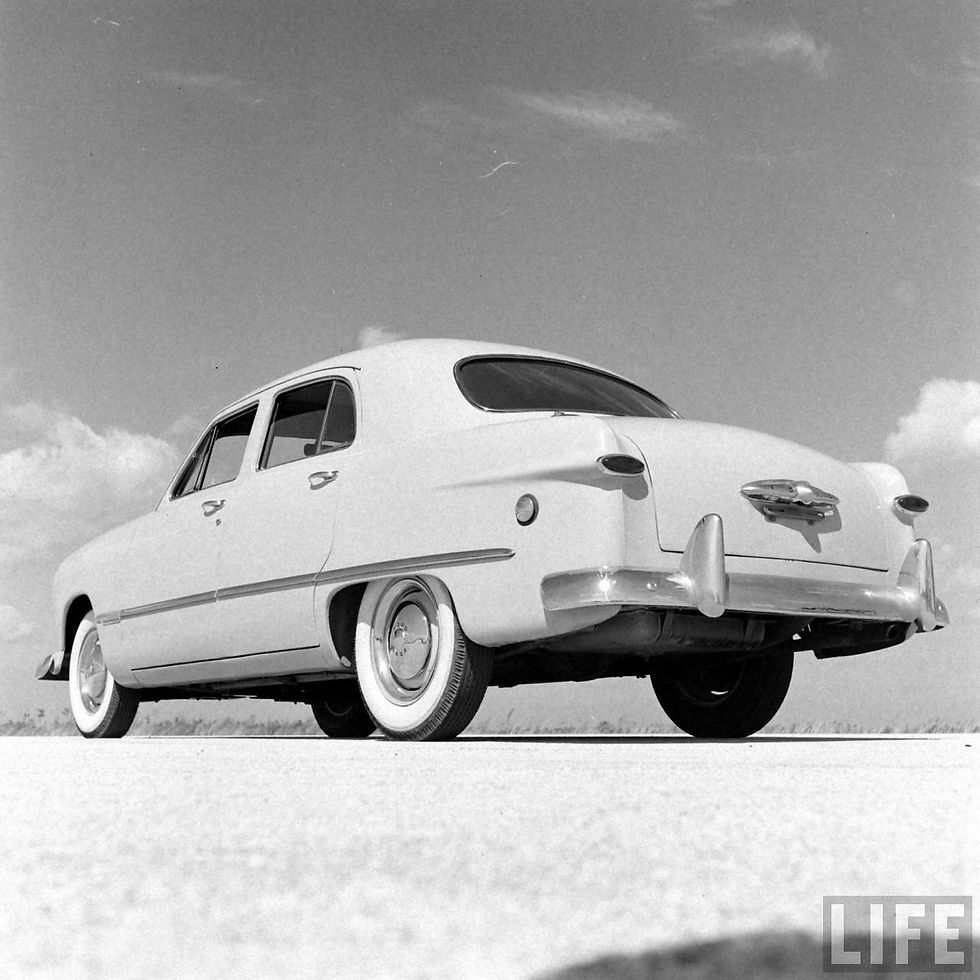
Het ontwerp van de '49 Ford had strakke, doorlopende flanken waarbij de traditionele, losse spatborden volledig waren verdwenen (het zogenaamde pontonmodel). De spatborden en de carrosserie vormden één geheel, waarbij de taillelijn bijna helemaal tot aan de ramen liep. De voorspatborden waren bijna net zo hoog als de motorkap en de achterspatborden liepen vrijwel door tot de bovenkant van de kofferbak.
Er was geen sprake meer van aflopende spatborden. De sierlijst op de zijkant was één strakke lijn van roestvrij staal die vlak achter de voorste wielkast begon, direct over de achterste wielkast liep en bijna tot de achterkant doorliep. De grille voorzien van een prachtige 'spinner' leek van voren gezien op een vliegtuigpropeller met vleugels. De achterkant had een uitgesproken kofferbak (bustle back) met een achterzijde die recht naar beneden liep. De voorruit bestond uit twee delen plat glas; de achterruit was heel breed en gebogen.
Wie Claimt Wat?
Het ontwerp werd gemaakt door Studebaker-ontwerpers Bob Bourke en Holden "Bob" Koto, onder supervisie van Caleal. Koto deed waarschijnlijk het meeste werk, terwijl Bourke de voorkant voor zijn rekening nam, inclusief de grille. De kleimodelleurs waren John Bird, Joe Thompson en John Lutz. Bourke hield vol dat het model een spinner-grille moest hebben die erg leek op het uiteindelijke productie-ontwerp. Joe Oros beweert echter met klem dat het gipsen schaalmodel toen het bij Ford binnenkwam alleen een gegoten balk in het midden had, en absoluut géén spinner.
Hier wordt het verhaal echt troebel. Caleal eiste de volledige eer op voor het ontwerp. Bourke gaf zichzelf en Koto vrijwel alle eer, en Caleal helemaal niets. John Bird gaf Caleal slechts een klein beetje credit. Van de drie ontwerpers en drie kleimodelleurs is vandaag de dag alleen Caleal nog in leven (noot: op het moment van schrijven in 2005).
Wat het uitzoeken zo moeilijk maakt, is dat er geen foto's lijken te bestaan van het oorspronkelijke schaalmodel. Als Caleal al foto's heeft gemaakt, zijn ze nooit gepubliceerd, en als er foto's in de archieven van Ford hebben gezeten, zijn die tientallen jaren geleden vernietigd. Caleal claimt dat hij de gipsen gietvorm jarenlang in zijn garage heeft bewaard en hem later aan het Henry Ford Museum heeft geschonken.
In 1996 ontmoette ik Bob Bourke in Dearborn (Michigan). Hij werd vergezeld door twee van zijn vroegere collega-ontwerpers, Tucker Madawick en Bob Andrews. We gingen naar het depot van het Henry Ford Museum waar we de gietvorm bekeken. Toen we naar buiten kwamen, schudde Bourke zijn hoofd en zei: "Dat is niet de gietvorm van de '49 Ford." Tucker Madawick, die nog leeft, kan getuigen dat hij dit heeft gezorgd. (Bourke en Andrews zijn inmiddels overleden).
Voordat ik mijn SIA-artikel in 1994 schreef, bracht ik een dag door bij Joe Oros thuis in Santa Barbara (Californië). Hij en Elwood Engel werkten onder George Walker aan het model op volle grootte in het Ford-gebouw. Het was een tweedeurs aan de ene kant en een vierdeurs aan de andere kant, net als het schaalmodel. Joe Oros vertelde dat het dak iets verhoogd werd voor meer hoofdruimte en een betere instap. De kofferbak werd aangepast om te voldoen aan de harde eis van de ingenieurs dat er een standaard melkbus in moest passen. De ronde wielkasten werden iets hoekiger gemaakt.
Deze auto werd, samen met de auto van Gregorie, getoond aan het directiecomité onder leiding van Henry Ford II. Het ontwerp werd verkozen boven dat van Gregorie, op twee aanpassingen na:
-
Op voorstel van Henry Ford II veranderde Elwood Engel de achterkant door de verticale achterlichten horizontaal te plaatsen en op te nemen in de achterschermen.
-
De voorkant van Caleals schaalmodel werd te anoniem gevonden. Joe Oros voegde de bekende spinner-grille toe en ontwierp ook het instrumentenpaneel dat dit spinner-thema herhaalde.
Welkom in de Twilight Zone
Tot zover het bekende verhaal. Maar hier stappen we de Twilight Zone binnen.
Ik heb er nooit bij gekund hoe Caleal en zijn team in slechts drie weken tijd met zo’n revolutionair ontwerp konden komen. Ik geloofde nooit helemaal in de verhalen van Caleal of Bourke over het keukentafel-incident. Ik vermoedde dat er bij Studebaker al eerder iets aan vooraf was gegaan. Ik hoorde hier al jaren geruchten over, maar had geen bewijs.
Tot ik circa twee jaar geleden hoorde dat er in Los Angeles een verzameling foto's bestond van de Ford van 1949... als Studebaker. Na veel telefoontjes kreeg ik die vijf foto's te zien. Eén foto leek sprekend op de 1949 Ford Club Coupé. Alle vijf de foto's droegen het opschrift "1946 Studebaker Champion Project". (Helaas zijn deze foto's niet vrijgegeven voor het publiek).
Na navraag bij het Studebaker Museum in South Bend en gesprekken met historici, vond ik via Studebaker-historicus Richard Quinn nog een paar foto's van deze kleimodellen uit 1946. Het lijkt erop dat er destijds vijf gipsen modellen op volle grootte zijn gebouwd. Het waren vierdeurs sedans aan de ene kant en tweedeurs coupés aan de andere kant. Eén van de sedans komt heel dicht in de buurt van de Ford van 1949: hij heeft strakke flanken zonder losse spatborden, maar met een lichte uitstulping boven de wielen. Ook het dak en de ramen lijken enorm op die van de '49 Ford.
Op een van die foto's staat een zijkant die vrijwel identiek is aan de '49 Ford. Er zijn sterke elementen van de Ford van 1949 te zien, al kun je niet zeggen dat het wás. De foto's hebben als onderschrift: "Champion 1946 model. Korte wielbasis, lichtgewicht. Gebouwd 6e maand, '46. Gipsen mock-up."
Er was ook een foto van kleinere tafelmodellen. Een van die modellen — een zwarte sedan — vertoont op de grille na een verbluffende gelijkenis met de '49 Ford. En onthoud: de spinner-grille werd pas later bij Ford op de auto getekend!
De Puzzelstukjes Vallen op hun Plek
Als ik alle verhalen, artikelen en foto's naast elkaar leg, ontstaat er een heel ander beeld van hoe de Ford van 1949 waarschijnlijk echt is ontstaan.
Al die kleinere modellen werden oorspronkelijk ontworpen door de ontwerpstudio van Raymond Loewy, die voor Studebaker werkte. De betrokken ontwerpers waren Bob Bourke, Holden Koto en Gordon Buehrig (het hoofd van de studio). Ook ontwerpers als Dick Caleal maakten destijds deel uit van dit team.
Virgil Exner, die ook voor Studebaker werkte, had een hekel aan Loewy. Samen met de hoofd-ingenieur van Studebaker, Roy Cole, ontwierp Exner in het geheim een alternatieve auto (op zijn eigen keukentafel/slaapkamer). De directie van Studebaker koos onverwacht voor het ontwerp van Exner (wat de uiteindelijke Studebaker van 1947 werd) en wees het strakke pontonmodel van het team van Loewy/Bourke/Koto af.
Toen het ontwerp van Exner in productie ging, moest Loewy bezuinigen en werd Richard Caleal ontslagen. Caleal lag erg goed in de groep en iedereen vond het erg dat hij weg moest. Toen Caleal hen later om hulp vroeg voor zijn opdracht voor George Walker, hielpen zijn oude collega's hem maar al te graag. (Zij dachten overigens dat ze een auto voor Nash aan het ontwerpen waren!).
Maar om in drie weken tijd uit het niets een compleet nieuw ontwerp te verzinnen én te bouwen, was onmogelijk. Wat hebben ze dus waarschijnlijk gedaan? Ze hebben een afgewezen Studebaker-ontwerp uit de kast getrokken — de strakke coupé die bij Studebaker was afgekeurd — en die snel opnieuw opgebouwd op de keukentafel van Caleal! Het enige wat ze echt veranderden, was het weglaten van de uitstulpingen rond de wielkasten.
Een Wraakactie?
Er gaat al jaren een gerucht dat de Studebaker-ontwerpers zo kwaad waren dat hun favoriete ontwerp bij Studebaker was afgekeurd, dat ze het uit wraak aan Caleal gaven om het aan een concurrent te verkopen. Zo zou de Ford van 1949 dus meer uit rancune dan uit iets anders zijn geboren. Ik heb dit verhaal nooit hard kunnen maken, maar de feiten wijzen wel in die richting.
Natuurlijk kon niemand van de Studebaker-ontwerpers dit openlijk toegeven. Als Loewy erachter was gekomen, had hij ze op staande voet ontslagen. Ze lieten de eer dus graag aan Caleal, die die eer op zijn beurt maar al te graag op zich nam.
Het volledige verhaal is al die jaren heel goed doofgepot. Ook bij Ford moet er een enorme doofpot zijn geweest op het hoogste niveau, want de echte feiten zouden een afgang zijn geweest voor de fabrikant: de auto die het bedrijf redden, bleek een afgedankt Studebaker-ontwerp te zijn!
Conclusie
Naar mijn mening vond de Ford van 1949 zijn oorsprong in de schaalmodellen van Studebaker uit 1945/1946. Het is heel goed mogelijk dat een geschrapt ontwerp van Studebaker de auto werd die de Ford Motor Company van de ondergang redde en een heel nieuw tijdperk in autodesign inluidde.
Vergeet niet dat de Studebaker uit 1947 en de Ford uit 1949, op de wielbasis na, exact dezelfde technische specificaties hadden. De gekozen Studebaker van 1947 werd een van de meest geavanceerde auto's van zijn tijd, maar die stijl doofde begin jaren vijftig uit.
Het ontwerp van de Ford van 1949 daarentegen veranderde de toekomst van auto-ontwerp voor de komende decennia. Ford had destijds de slogan: "There’s a Ford in your future." Mijn inziens wás de Ford van 1949 ook echt de toekomst.
(Dit artikel verscheen oorspronkelijk in het nummer van 1 mei 2005 van Hemmings Classic Car).
Via de website 'Shoeboxford' van een Braziliaanse fan kwam ik een mooie tekst tegen over de ontwikkeling van de nieuwe Forty-Niner. Oorspronkelijk gepost op oldcarscanada.blogsport.com, maar daar is het verhaal verdwenen. Hier een vertaling van het artikel:
George Walker was verantwoordelijk voor het ontwerp van de Ford 1949, maar oorspronkelijk had hij het ontwerp voor Nash bedoeld.
De onafhankelijke autostylist en industrieel adviseur George Walker en zijn team stonden aan de basis van de revolutionaire, volledig nieuwe carrosserie die uiteindelijk de eerste naoorlogse Ford zou worden. Met zijn schetsen onder de arm ging Walker langs bij verschillende autofabrikanten om zijn ontwerp aan de man te brengen. Dat was in die tijd heel gebruikelijk. Slechts weinig autofabrikanten hadden een eigen ontwerpafdeling. En zelfs fabrikanten die daar wel over beschikten, maakten regelmatig gebruik van externe ontwerpers om hun eigen ontwerpers scherp te houden.
Walker maakte een afspraak met George Mason van Nash-Kelvinator en reed naar het art-decokantoor van het bedrijf aan Plymouth Road. Mason was enthousiast over het ontwerp. De gladde, gestroomlijnde carrosserie sloot precies aan bij de richting die hij voor Nash voor ogen had.
George Walker was bij Nash al een bekende en geliefde ontwerper. Hij had de opvallende modellen voor 1939 ontworpen. Die vielen goed in de smaak bij het publiek en bezorgden Nash een bijzonder goed verkoopjaar.
Toen Walker het met mahoniehout beklede kantoor van Mason verliet, verkeerde de Nash-topman in de veronderstelling dat hij het ontwerp van de getalenteerde stylist zou kopen. Walker wachtte af, maar er werd nooit een overeenkomst getekend. Toen er vanuit Nash niets meer van zich liet horen, nam Walker zijn schetsen uiteindelijk mee naar Dearborn, voor een nieuwe presentatie.
De Ford-functionarissen waren onder de indruk. Ze gaven Walker de belangrijkste uitgangspunten waaraan de nieuwe auto moest voldoen en vroegen vervolgens om meerdere concurrerende ontwerpen: één van Walker en één van de eigen ontwerper Bob Gregorie.
Walker besloot niet één, maar drie voorstellen in te dienen. Het project werd met zeer beperkte middelen uitgevoerd. Zo werd naar verluidt één van de drie kleimodellen op driekwart van ware grootte zelfs uitgehard in de keukenoven van Walkers medewerker Richard Caleal. De klei zou daarbij zo'n stank hebben veroorzaakt dat het hele huis ernaar rook.
De vier voltooide modellen werden op 1 augustus 1946 aan de hoogste Ford-leiding gepresenteerd. De Ford-directie koos voor het ontwerp van Walker en sloot een overeenkomst met hem.
Toen George Mason ontdekte wat er was gebeurd, was hij woedend. Het nieuwe model dat eigenlijk de Nash van 1949 had moeten worden, was op de een of andere manier aan zijn neus voorbijgegaan en zou nu een Ford-embleem dragen.
Mason zorgde er vervolgens voor dat zoiets nooit meer kon gebeuren. Hij richtte een eigen ontwerpafdeling voor Nash op. Maar dat is weer een ander verhaal.
Met het contract op zak begon de Ford steeds meer vorm te krijgen. Walker werkte daarbij onder leiding van Harold Youngren, Fords vicepresident Engineering. De wielbasis bleef gelijk aan die van de voorgaande Fords, maar daarmee hield de overeenkomst met het verleden eigenlijk wel op. De nieuwe Ford was drie inch lager. Door de gladde, vlakke flanken leek de auto bovendien smaller. Dat was hij ook daadwerkelijk. De auto was daarnaast lichter. Toen de nieuwe Ford klaar was, had hij nog maar weinig gemeen met de Ford van 1948. De auteur vergelijkt het verschil met het verschil tussen versgeperst sinaasappelsap uit Florida en Tang.
De grille was bewust ingetogen gehouden. Een eenvoudige chromen strip werd in het midden onderbroken door een sierlijke ronde chromen cirkel. Daarachter lag een vrijstaand ogende carrosserie die sterk aan een vliegtuigromp deed denken. De uiteinden van de chromen strip liepen door tot buiten de grille en vormden tevens de houders voor de parkeerlichten. Het ontwerp met de gladde, vlakke zijkanten werd ook aan de achterkant doorgezet. Daar werd het onderbroken door ovale achterlichten, die waren opgenomen in een kleine, vinachtige uitstulping.
Het interieur werd enorm ruim doordat de motor maar liefst vijf inch naar voren werd geplaatst. De volledige ruimtewinst werd benut voor meer beenruimte. Dankzij het nieuwe, hoekige ontwerp kon de breedte van de voorbank met zes inch worden vergroot. Zelfs de drie inch lagere carrosserie had geen nadelige gevolgen voor de binnenruimte. Een man kon nog altijd zijn fedora opzetten zonder het dak te raken.
Het dashboard werd omschreven als "door vliegtuigen geïnspireerd". Het instrumentenpaneel was overzichtelijk en voorzien van een grote, ronde snelheidsmeter met witte cijfers en wijzers op een zwarte achtergrond.
De vierdeurs sedan was oorspronkelijk ontworpen met beide deuren aan de middenstijl scharnierend. Op het laatste moment werd dat ontwerp echter geschrapt en koos Ford voor de conventionele deurindeling.
De zogenaamde suicide doors waren dus aanvankelijk gepland, maar werden uiteindelijk vervangen. Ford had de promotieauto's voor dealers echter al verstuurd met de inmiddels geschrapte deurconfiguratie.
De Ford 1949 werd vanaf de eerste tekeningen tot aan de productie in slechts 19 maanden ontwikkeld. Dat was uitzonderlijk snel. Normaal gesproken duurde de ontwikkeling van een compleet nieuwe auto ongeveer drie jaar. De investering was enorm: naar schatting 10 miljoen arbeidsuren en 72 miljoen dollar.
Aan de zescilinder- en achtcilindermotoren veranderde ten opzichte van de Ford uit 1948 niet bijzonder veel. De technici verbeterden wel het koelsysteem en zorgden voor een betere lucht- en gasdoorstroming.
Ondanks deze aanpassingen bleef het vermogen volgens de fabriek 100 pk. Dat was overigens ruim voldoende, want de nieuwe Fords waren aanzienlijk lichter dan hun voorgangers.
De traditionele aandrijving met een torque tube werd vervangen door een Hotchkiss-aandrijflijn.
Echt nieuw voor Ford waren de onafhankelijke voorwielophanging en de in lengterichting geplaatste bladveren voor de achteras. De compleet nieuwe auto kreeg bovendien een ladderchassis.
Om de concurrentie voor te zijn, werden de nieuwe Fords op 8 juni 1948 aan de pers voorgesteld tijdens de Canadian National Exhibition in Toronto. Honderden journalisten kwamen naar het evenement in het Automotive Building. Ze waren enthousiast over het ontwerp en schreven lovende verhalen over de nieuwe Ford. Tijdens de eerste drie dagen dat de auto's bij de dealers stonden, stroomden de showrooms van Ford vol. De negen nieuwe modellen waren de grote sterren van de show. Een hardtop ontbrak in het programma. Ford had eenvoudigweg niet het geld om de benodigde productiegereedschappen daarvoor te ontwikkelen.
De stationwagen was uitsluitend als tweedeurs verkrijgbaar. Ook een automatische transmissie ontbrak. Ford had dat jaar geen automaat beschikbaar omdat de onderhandelingen om automatische transmissies van Studebaker te kopen waren mislukt. De bezoekers leken zich daar echter weinig van aan te trekken. Voor hen was eigenlijk maar één ding hetzelfde gebleven als het jaar ervoor: de lucht in de banden.
De klanten plaatsten massaal bestellingen voor de slanke nieuwe Fords. De auto's waren licht, wendbaar en snel en werden daardoor ook bij veel politiekorpsen bijzonder populair. De gewaagde en kostbare gok betaalde zich uiteindelijk ruimschoots uit. 1949 werd een bijzonder succesvol jaar voor Ford.
In Windsor, Ontario, werden tijdens het lange modeljaar 38.280 exemplaren geproduceerd.
LIFE Magazine is in maart 1948 meegegaan met de fotoshoot van de nieuwe 1949 Ford. De foto's zijn gemaakt op 201 Trismen Terrace, Orlando, Florida door onder andere William J. Sumits. Zover bekend zijn de foto's echter nooit allemaal gepubliceerd en alleen maar naar buiten gekomen doordat Google het archief van LIFE magazine had gedigitaliseerd. Een selectie is geplaatst in de editie van 14 juni 1948, net na de introductie in het Waldorf Astoria Hotel.
Een auto van alles-of-niets
De betekenis van de nieuwe Ford voor Ford Motor Company was heel anders dan bijvoorbeeld de Chevrolet-modellen uit 1955, 1956 en 1957 later zouden zijn voor General Motors.
Dit was alles of niets. De urgentie was hoog, met uitzondering van de motor, is de complete auto in slechts tweeënhalf jaar werd ontworpen, ontwikkeld, gebouwd en op de markt gebracht.
De geheime fotosessie
Het verhaal is als volgt. De Ford werd in juni 1948 als modeljaar 1949 geïntroduceerd tijdens een groot feest in het Waldorf Astoria in New York. Het gaat om meer dan 230 foto's, gemaakt tijdens drie dagen die volledig waren gewijd aan het fotograferen en filmen van de nieuwe Ford voor de enorme reclamecampagne die op het punt stond te beginnen. Op sommige foto's zie je de eerste auto's naar de locatie worden gebracht. Hier zijn ze nog te zien op de vrachtwagens waarmee ze onder volledige geheimhouding naar de fotosessie werden vervoerd. Juist omdat het foto's zijn van een geheim dat inmiddels geen geheim meer is, zijn ze allemaal bijzonder en prachtig. Bovendien zijn ze zeer professioneel gemaakt. Henry Ford heeft kosten noch moeite gespaard.
De markt wist dat Ford al jaren bezig was met een nieuwe auto, maar niemand wist precies wat die auto zou betekenen. Zoals gezegd werd de auto zelf pas drie maanden later, in juni van datzelfde jaar, officieel aan het publiek getoond. Popular Science wist de eerste foto's en informatie te bemachtigen na langdurige en moeizame onderhandelingen met Ford. De foto's die hier volgen zijn overigens niet de officiële Ford-foto's, maar foto's die LIFE Magazine maakte. LIFE reisde mee met het team van het reclamebureau dat Ford voor de campagne had ingehuurd en volgde hen gedurende de drie of vier dagen dat de fotosessies op locatie plaatsvonden. Waarom LIFE de foto's destijds niet publiceerde is onbekend.
Pre productie auto's
In een boek over de Shoebox wordt vermeldt dat de productie van de prototypes voor de nieuwe Ford uit 1949, bekend als het Model BA, begin april 1948 in de River Rouge fabriek van start ging. Deze eerste auto's dienden om kinderziektes aan de lopende band te verhelpen. Daarna werden ze compleet naar andere Ford-fabrieken gestuurd, waar ze werden gebruikt voor de laatste aanpassingen, waardoor de productie sneller kon beginnen. Het werd duidelijk dat elke fabriek op deze manier een eigen kwaliteit zou hebben, wat ongetwijfeld heeft bijgedragen aan een aantal chronische defecten van de auto's uit dat eerste jaar. Deze defecten waren in sommige fabrieken duidelijker aanwezig dan in andere.
Omdat Lincoln en Mercury ook nieuwe auto's kregen, betekende het dat alles veranderd moest worden en alle machines aangepast moesten worden aan de specificaties van de nieuwe auto's. Op typische Ford-wijze bracht een auto, voor de vierde keer in zijn 45-jarige geschiedenis, ingrijpende veranderingen teweeg, waardoor de manier waarop Ford zijn auto's bouwde, produceerde en verkocht radicaal veranderde. Dit was het geval met de Model T, vervolgens de A, later de B, en nu de BA.
Als de auto's pas in april 1948 van de lopende band rolden, wat voor auto's zien we dan op deze foto's? Dat zullen pre productie auto's zijn.
Foto-set van het transport naar de foto locatie en het uitladen


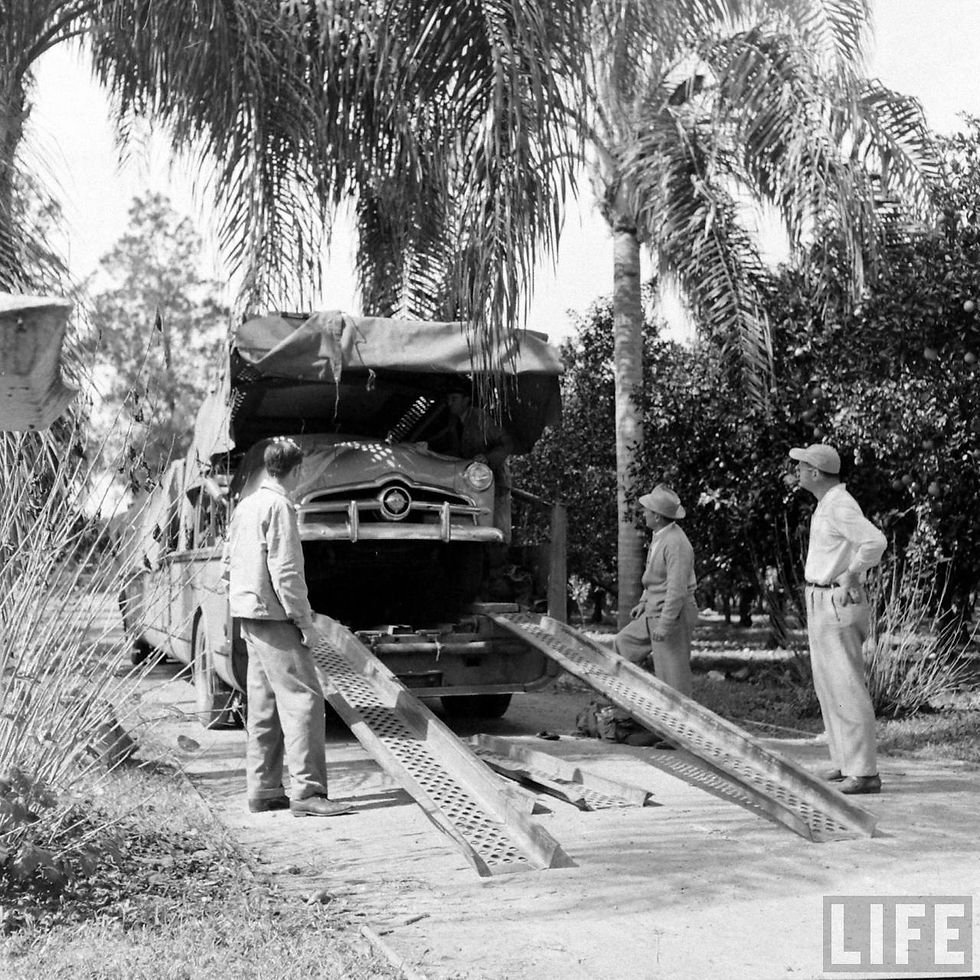




Voorbereidingen voor de foto shoot waarbij de zakken zand voor een mooie stance zorgde.
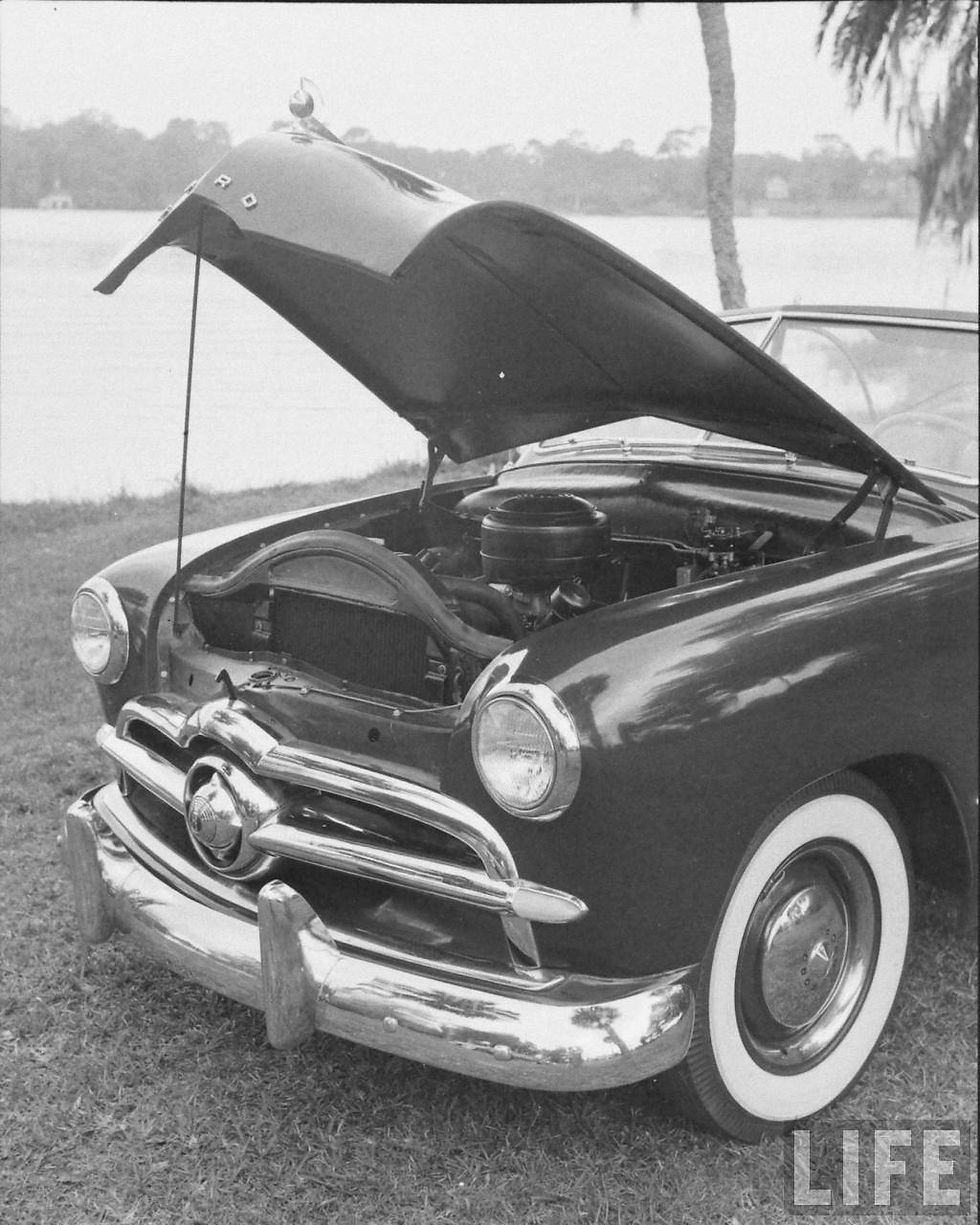


LIFE legt de fotoshoot van Ford vast, foto's van het proces en van de dames bij de auto's
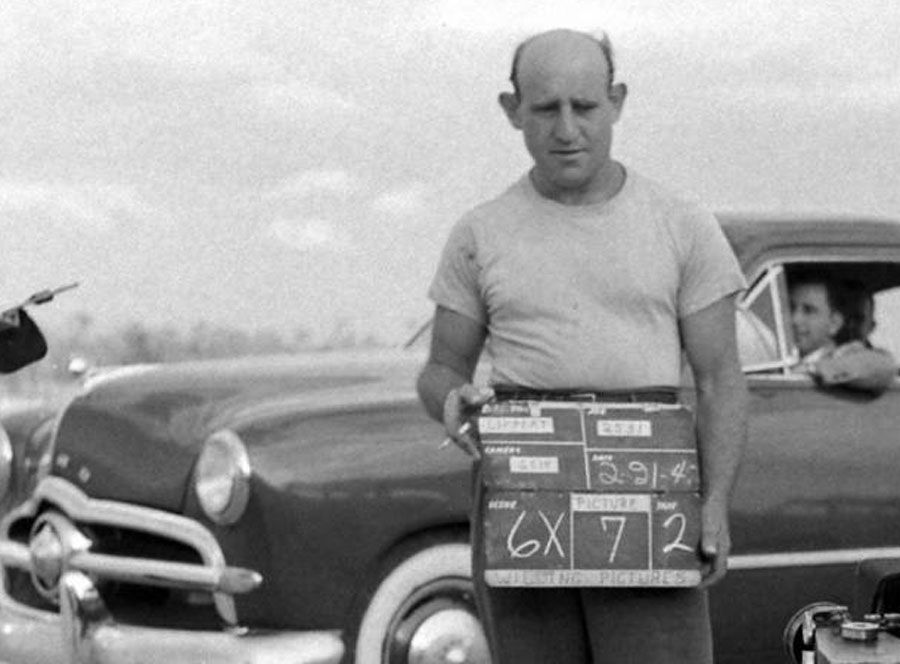


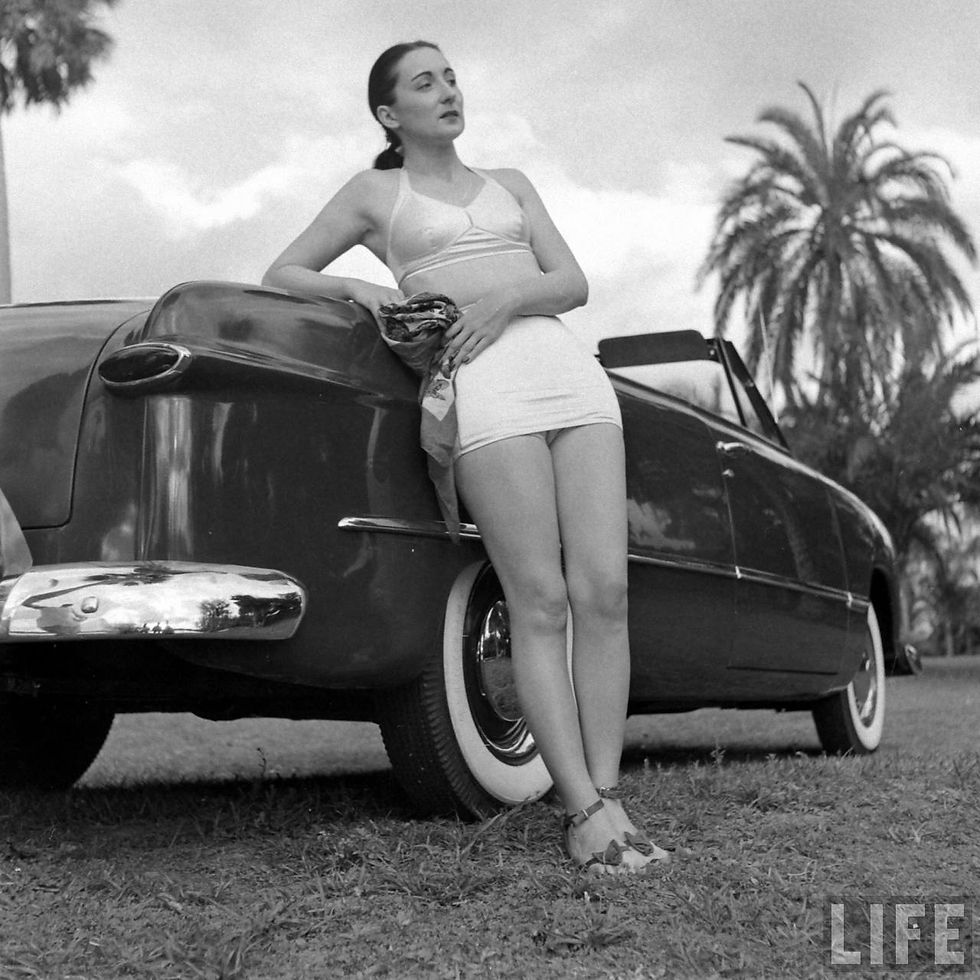


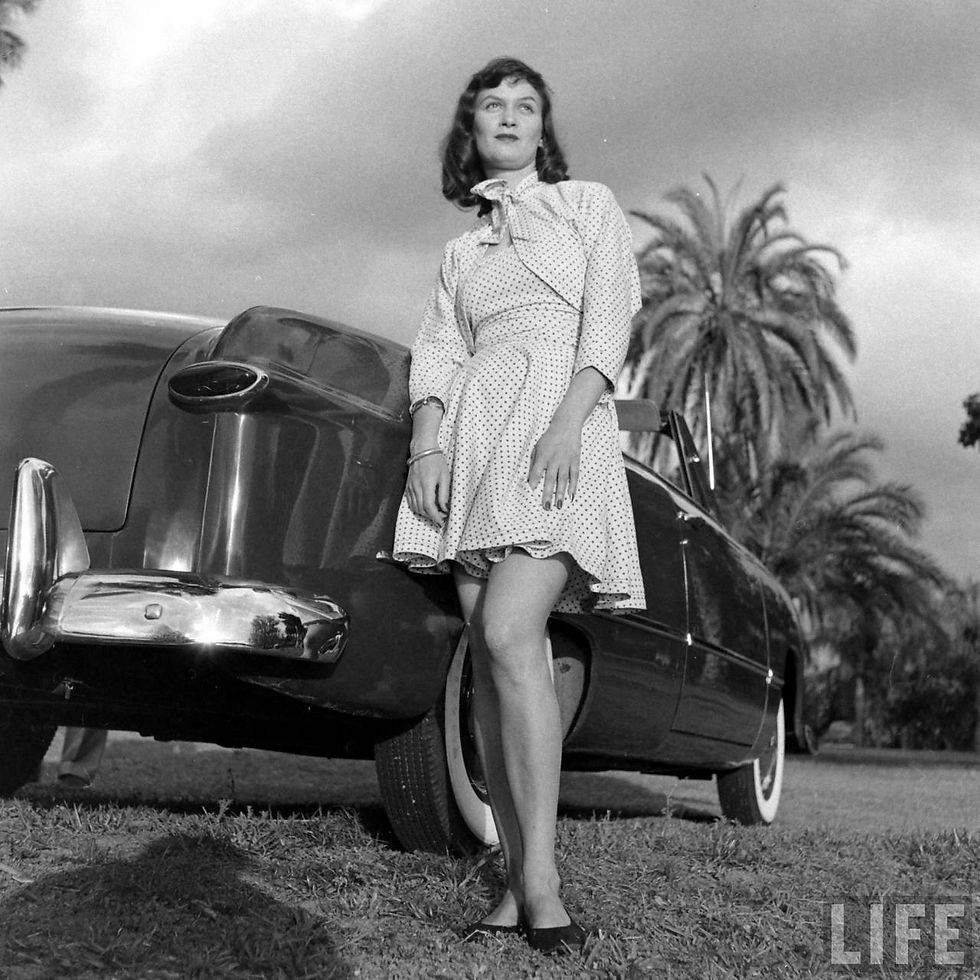


De fotoshoot zelf, ook vastgelegd door LIFE